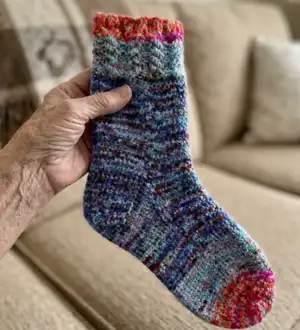
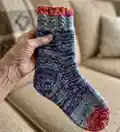
Make cozy, marled socks with the Thicksgiving Pattern — a collection of three variations (Vanilla, Ribbed, and Cables) that celebrate knitting with two yarns held together. You will love the squishy fabric created by marling and the clear, step-by-step instructions for forethought heels, traditional heel flaps, and toe shaping. Perfect for gifting or keeping for chilly mornings by the fire.
Progress Tracker
0% Complete
— Thicksgiving Vanilla :
Info :
SIZES*Measured around the circumference of the ball of your foot* S (7"/17.5cm) M (8"/20.25cm) L (9"/23cm) XL (10"/25.5cm)
Info :
GAUGE 26 sts over 4"/10cm and 28 rows, knit in the round and blocked
Info :
MATERIALS Fingering Weight Sock Yarn *Color A: approximately 200 - 230 yards /183 - 210m (Hedgehog Fibres Sock "Seed") *Color B: approximately 200 - 230 yards/183 - 210m (Hedgehog Fibres Sock "Monarch") *Color C: approximately 30 - 40 yards/27.5 - 36.5m (Hedgehog Fibres Sock "UFO") *Color D: approximately 30 - 40 yards/27.5 - 36.5m (Hedgehog Fibres Sock "Sorry Not Sorry")
Info :
*US size 4/3.5mm knitting needles (DPNs, or 36" or longer circular needle for magic loop) *Tapestry needle for weaving in ends
Info :
ABBREVIATIONS: K Knit P Purl SSK Slip, slip, knit K2tog Knit two together St Stitch M Marker BOR Beginning of Round Rnd Round CO Cast on Sl Slip Pm Place marker
Item Name (Cuff) :
With colors A and C held together, CO 40 (44, 48, 52) sts and join for working in the rnd, being careful not to twist your sts.
Round 1 :
[k2, p2] around to end.
Info :
Continue in established 2 x 2 ribbing pattern until cuff measures 1.75"/4.5cm, or your desired length.
Item Name (Leg) :
Cut color C and pick up color B. With A and B held together, k even in stockinette until your leg reaches your desired length. I knit mine 6"/15.25cm from the start of my cuff to the start of the heel.
Item Name (Placing the Waste Yarn for the Heel) :
This pattern calls for a Forethought Heel. You will be knitting in a line of waste yarn where your heel will eventually be knit into the sock.
Round 1 :
Knit across the first 20 (22, 24, 26) sts. Next, pick up a strand of waste yarn and knit across the remaining 20 (22, 24, 26) sts. Transfer those sts you just knit in your waste yarn from your right needle back on to your left needle. Using your working strands of yarn (which should be colors A and B held together), knit across all those waste yarn sts.
Info :
You have now placed your waste line for your forethought heel, and are ready to begin your foot!
Item Name (Foot) :
Continue working in stockinette with colors A and B held together until your foot reaches your desired length.
Info :
If you are knitting gift socks, or you can't easily try them on as you knit, the Craft Yarn Council has issued the following length guidelines for the foot of a sock, measured from the back of the heel to the end of the toe (You can measure from the waste yarn line. If you are trying on your sock, the waste yarn line should be centered on your heel, about in line with your ankle bone).
Info :
(All sizes are US) Women's shoe sizes 4-6.5: 8 - 9" (20.25 - 23cm) Women's shoe sizes 7-9.5: 9.25 -10" (23.25 - 25.5cm) Women's shoe sizes 10-12.5: 10.25 -11" (26 - 28cm) Men's shoe sizes 6-8.5: 9.25 -10" (23.25 - 25.5cm) Men's shoe sizes 9-11.5: 10.25 -11" (26 -28cm) Men's shoe sizes 12-14: 11.25 -12" (28.5 -30.5cm)
Info :
You will want to start your toe decreases at approximately 1.5"/3cm before the end of your desired foot length.
Item Name (Toes) :
Cut yarn A and join Yarn D. With yarns B and D held together, knit 1 row even in stockinette, then begin your toe decreases as follows:
Row 1 :
k1, ssk, k 14 (16, 18, 20) sts, k2tog, K1, pm, k1, ssk, k 14 (16, 18, 20) sts, k2tog, k1.
Row 3 :
k1, ssk, k to 3 sts before marker, k2tog, k1, slip marker, k1, ssk, k to 3 sts before BOR, k2tog, k1.
Info :
Repeat rows 2 and 3 until 10 (12, 14, 16) sts remain. Using Kitchener Stitch, graft toe sts closed.
Item Name (Knitting the Heel) :
To knit your peasant heel, you first need to get your heel stitches back on your needles. You currently have half your stitches knit into a strand of waste yarn. You will be picking up those stitches on either side of your waste yarn, plus an additional stitch at each end of your waste yarn on both sides, giving you 44 (48, 52, 56) sts total on your needles.
Info :
Make sure your work is right side out. You will be picking up the right leg of each stitch directly below your waste yarn. Identify the stitch just before your first waste yarn stitch. With your needle, pick up the right leg of the stitch directly below. Then pick up the right leg of the stitch directly below your first waste yarn stitch. Pick up the right leg of the second stitch below your waste yarn.
Info :
Continue picking up the right leg of each stitch below your waste yarn until you reach the end. Pick up the right leg of the stitch below the first stitch after your waste yarn ends. You have now picked up half your heel stitches, plus an additional stitch at each end! Repeat these steps for the stitches on the other side of your waste yarn.
Info :
Once your heel stitches have been picked up, remove the waste yarn (if you are using Magic Loop, slide all your stitches onto the cables - it's much easier to tease out the waste yarn this way!).
Info :
Once the waste yarn is removed, k 1 round even with yarns B and D held together, then begin your decreases to shape the heel (this is done exactly the same as your decreases for shaping your toes!).
Row 1 :
k1, ssk, k 16 (18, 20, 22) sts, k2tog, k1, pm, k1, ssk, k 16 (18, 20, 22) sts, k2tog, k1.
Row 3 :
k1, ssk, k to 3 sts before marker, k2tog, k1, slip marker, k1, ssk, k to 3 sts before BOR, k2tog, k1.
Info :
Repeat rows 2 and 3 until 10 (12, 14, 16) sts remain. *Note: you can adjust the depth of your heel by doing more or less decreases to get a perfect fit! Try the sock on occasionally as you work your decreases to see how it's fitting! Stop your decreases when you can easily pinch the fabric closed.
Item Name (Finishing) :
Weave in all your ends and block your socks!
— Thicksgiving Ribbed :
Info :
SIZES*Measured around the circumference of the ball of your foot* S (7"/17.5CM) M (8"/20.25cm) L (9"/23cm) XL (10"/25.5cm)
Info :
GAUGE 32 sts over 4"/10cm and 28 rows, knit in the round in rib pattern and blocked
Info :
MATERIALS Fingering Weight Sock Yarn *Color A: approximately 230 - 260 yards/210 - 237m (Hedgehog Fibres Sock "Heron") *Color B: approximately 230 - 260 yards/210 - 237m (Hedgehog Fibres Sock "Seed") *Color C: approximately 50 - 60 yards/45.75 - 55m (Hedgehog Fibres Sock "Fly")
Info :
*US size 4/3.5mm knitting needles (DPNs, or 36" or longer circular needle for magic loop) *Tapestry needle for weaving in ends
Item Name (Cuff) :
With colors A and C held together, CO 44 (48, 52, 56) sts and join for working in the rnd, being careful not to twist your sts.
Round 1 :
[k2, p2] around to end.
Info :
Continue in established 2 x 2 ribbing pattern until cuff measures 2"/5cm, or your desired length.
Item Name (Leg) :
Cut color C and pick up color B. With A and B held together, continue working in established 2 x 2 ribbing pattern until your leg reaches your desired length. I knit mine 6"/15.25cm from the start of my cuff to the start of the heel.
Item Name (Heel Flap) :
This pattern calls for a traditional heel flap and gusset! You will be working your heel back and forth across the back half of your sts.
Row 1 :
Knit across the first 22 (24, 26, 28) sts in established ribbing pattern. Next, knit even in stockinette across the last 22 (24, 26, 28) sts. Turn work and establish the following pattern:
Info :
Repeat rows 1 and 2 until your heel flap measures 1.75 (2, 2, 2.25)"/4.5 (5, 5, 5.75)cm, ending after working a purl row.
Item Name (Heel Turn) :
Row 1: sl 1, k 11 (12, 13, 14), ssk, k1, turn. Row 2: sl 1, p 3, p2tog, p1, turn. Row 3: sl 1, k 4, ssk, k1, turn. Row 4: sl 1, p 5, p2tog, p1, turn.
Info :
You have now established the following pattern for your heel turn: sl 1, k or p to one stitch before the gap created by turning on the previous row, ssk or p2tog, k1 or p1, turn. Continue in this pattern until all of your heel stitches have been worked.
Item Name (Gusset) :
With the right side of your work facing, and starting on the left side of your heel flap, pick up and knit 8 (9, 10, 11) sts, place BOR marker, k 22 (24, 26, 28) sts across front of sock in 2 x 2 rib pattern, pm, pick up and knit 8 (9, 10, 11) sts, knit across heel flap, k down the first set of picked-up sts to the BOR marker. You are now ready to begin the gusset decreases, which are worked as follows:
Row 1 :
Work across front of sock to marker, sl m, k1, ssk, k around to 3 sts before BOR marker, k2tog, k1.
Row 2 :
Work even with no decreases.
Info :
Repeat these two rounds until you have 44 (48, 52, 56) sts on your needles.
Item Name (Foot) :
With colors A and B held together, continue working your 2 x 2 ribbing pattern across the first 22 (24, 26, 28) sts, and working stockinette across the remaining 22 (24, 26, 28) sts.
Item Name (Toes) :
Cut yarn B and join Yarn C. With yarns A and C held together, knit 1 row even in stockinette, then begin your toe decreases as follows:
Row 1 :
k1, ssk, k 16 (18, 20, 22) sts, k2tog, K1, pm, k1, ssk, k 16 (18, 20, 22) sts, k2tog, k1.
Row 3 :
k1, ssk, k to 3 sts before marker, k2tog, k1, slip marker, k1, ssk, k to 3 sts before BOR, k2tog, k1.
Info :
Repeat rows 2 and 3 until 10 (12, 14, 16) sts remain. Using Kitchener Stitch, graft toe sts closed.
Item Name (Finishing) :
Weave in all ends and block your sock.
— Thicksgiving Cables :
Info :
SIZES*Measured around the circumference of the ball of your foot* S (7"/17.5CM) M (8"/20.25cm) L (9"/23cm) XL (10"/25.5cm)
Info :
GAUGE 28 sts over 4"/10cm and 28 rows, knit in the round cable pattern and blocked
Info :
MATERIALS Fingering Weight Sock Yarn *Color A: approximately 220 - 250 yards /183 - 210m (Hedgehog Fibres Sock "Ozone") *Color B: approximately 150 - 170 yards/183 - 210m (Hedgehog Fibres Sock "Method") *Color C: approximately 60 - 80 yards/27.5 - 36.5m (Hedgehog Fibres Sock "Crystal") *Color D: approximately 40 - 60 yards/27.5 - 36.5m (Hedgehog Fibres Sock "Pucker")
Info :
*US size 4/3.5mm knitting needles (DPNs, or 36" or longer circular needle for magic loop) *Tapestry needle for weaving in ends
Item Name (Cuff) :
With colors A and D held together, CO 42 (48, 54, 54) sts and join for working in the rnd, being careful not to twist your sts.
Round 1 :
[k2, p2] around to end. Continue working in established 2 x 2 ribbing until work measures 1"/2.5cm.
Item Name (Leg) :
Cut yarn D and join in yarn C. With yarns A and C held together, begin following cable pattern:
Row 1 :
[p2, k4] around to end.
Row 2 :
[p2, k4] around to end.
Row 3 :
[p2, C4F, p2, C4B] around to end.
Row 4 :
[p2, k4] around to end.
Row 5 :
[p2, k4] around to end.
Row 6 :
[p2, k4] around to end.
Row 7 :
[p2, C4F, p2, C4B] around to end.
Info :
Repeat rows 4-7 three more times. Then repeat rows 4 and 5 once more.
Info :
Cut yarn C and join in yarn B. With yarns A and B held together, work even in stockinette until work measures 6.5"/16.5cm, or desired length. For sizes S, L, and XL, make the following increases or decreases on the first round only of your stockinette:
Info :
S and XL: k1, m1L, k around to 3 sts before the end of rnd, m1L, k1. 44 and 56 sts. L: k1, k2tog, k around to 3 sts before the end of rnd, k2tog, k1. 52 sts.
Item Name (Heel Flap) :
This pattern calls for a traditional heel flap and gusset! You will be working your heel back and forth across the back half of your sts.
Row 1 :
Knit across the first 22 (24, 26, 28) sts in established ribbing pattern. Next, knit even in stockinette across the last 22 (24, 26, 28) sts. Turn work and establish the following pattern: Row 1: P. Turn work. Row 2: K. Turn work.
Info :
Repeat rows 1 and 2 until your heel flap measures 1.75 (2, 2, 2.25)"/4.5 (5, 5, 5.75)cm, ending after knitting a purl row.
Item Name (Heel Turn) :
Row 1: sl 1, k 11 (12, 13, 14), ssk, k1, turn. Row 2: sl 1, p 3, p2tog, p1, turn. Row 3: sl 1, k 4, ssk, k1, turn. Row 4: sl 1, p 5, p2tog, p1, turn.
Item Name (Gusset) :
With the right side of your work facing and starting on the left side of your heel flap, pick up and knit 8 (9, 10, 11) sts, place BOR marker, k 22 (24, 26, 28) sts across front of sock in 2 x 2 rib pattern, pm, pick up and knit 8 (9, 10, 11) sts, knit across heel flap, k down the first set of picked-up sts to the BOR marker. You are now ready to begin the gusset decreases, which are worked as follows: Row 1: Work across front of sock to marker, sl m, k1, ssk, k around to 3 sts before BOR marker, k2tog, k1. Row 2: Work even with no decreases. Repeat these two rounds until you have 44 (48, 52, 56) sts on your needles.
Item Name (Foot) :
Continue working even in stockinette with colors A and B held together until your foot reaches 3.5"/9cm short of your desired length.
Item Name (Toes) :
Cut color B and join in color C. With yarns A and C held together, continue knitting even in stockinette for 2"/5cm, then begin your toe decreases as follows:
Row 1 :
k1, ssk, k 16 (18, 20, 22) sts, k2tog, K1, pm, k1, ssk, k 16 (18, 20, 22) sts, k2tog, k1.
Row 3 :
k1, ssk, k to 3 sts before marker, k2tog, k1, slip marker, k1, ssk, k to 3 sts before BOR, k2tog, k1.
Info :
Repeat rows 2 and 3 until 10 (12, 14, 16) sts remain. Using Kitchener Stitch, graft toe sts closed.
Item Name (Finishing) :
Weave in all ends and block your socks!
These Thicksgiving Socks are a celebration of cozy knitting and marled color blends, perfect for cold-weather comfort and mindful crafting. Whether you choose vanilla stockinette, crisp 2x2 ribbing, or charming cables, each pair knits up into a warm, squashy sock ready for gifting or wearing. Happy knitting and warm toes ahead! 🧦🧶