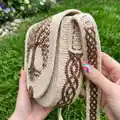
About This Tree of Life Leather Bag Pattern
This pattern provides full-size printable templates and assembly diagrams to create a Tree of Life leather crossbody bag. It includes flap artwork placement, stitch-hole guides, and clear part labels to guide cutting and punching. The templates cover flap, flap reinforcement, back panel, front panel, gusset, D-ring straps and shoulder straps.
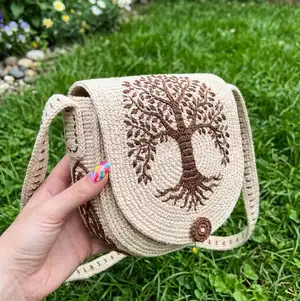
Measurements for key straps are provided (50 cm / 20 in and 110 cm / 43 in). The pattern is ideal for hand-stitching and finishing with rivets, snaps or decorative tooling.
Why You'll Love This Tree of Life Leather Bag Pattern
I absolutely love this pattern because it blends classic leathercraft with a decorative Tree of Life motif that feels timeless. I designed the templates so you can see exact stitch-hole placement, which saves time and reduces guesswork. I enjoy how the pattern supports both functional assembly and decorative detailing like the gusset braid and flap artwork. I also love offering clear, printable pieces that make cutting and punching straightforward for intermediate leatherworkers.
Switch Things Up
I love experimenting with finishes on this bag pattern; try tooling or pyrography on the flap motif for a deeper, antique look.
You can switch leather colors to create contrast: a dark gusset with a lighter flap really highlights the Tree of Life motif.
I often replace the fixed shoulder strap with an adjustable buckle for more wearable versatility on different outfits.
Want a lighter weight bag? Use thinner leather for the gusset and reinforcement, but add a fabric lining to increase structure without bulk.
I sometimes add decorative stitching in a contrasting thread color along the gusset braid to make the pattern pop visually.
Try using brass hardware for a vintage feel or matte black hardware for a modern minimalist look depending on your wardrobe.
Swap the snap closure for a small buckle or magnetic clasp to change the opening style and ease of use.
If you prefer vegan materials, try a high-quality synthetic leather and adapt your punch size accordingly for thread thickness.
I recommend experimenting on scrap leather first to confirm hole spacing, thread thickness and tension before committing to the full assembly.
Feel free to add internal pockets or a small zipped compartment on the front panel for extra functionality and personalization.
Common Mistakes & How to Fix Them
✗ Cutting outside the printed seam allowance can change final fit; always add or follow the specified edge allowance and trim carefully before punching.; solution.
✗ Misaligning flap artwork with stitch holes causes uneven closure; align the central motif with the punch guides and clamp pieces before punching holes.; solution.
✗ Using the wrong leather thickness will affect stitch spacing and fit; match your leather thickness to the pattern recommendations and adjust hole size or thread accordingly.; solution.
✗ Skipping reinforcement on stress points leads to premature wear; add the flap reinforcement and D-ring straps exactly as shown to distribute strain and stitch securely.; solution.