🧢 Beautiful ✨ Detailed πŸ’ Adorable

Ruffled By The Wind Pattern

Ruffled By The Wind Pattern
4.3β˜… Rating
5-7 Hours Time Needed
3.5K Made This
βœ‚οΈ

Intermediate Level

Ideal for those with basic crochet experience, featuring slightly more advanced stitches and techniques to expand your skills.

⏱️

Weekend Treat

Takes 5-7 hours, making it an enjoyable project to finish over a couple of days.

πŸ€—

Soft Hug

Gentle, plush, and full of warmth, creating a sense of comfort and coziness wherever they find a home.

About This Ruffled By The Wind Pattern

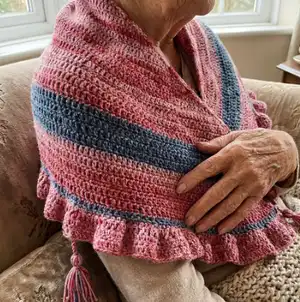
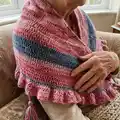
This pattern creates a crescent-shaped knitted shawl with a ruffled edge designed to bloom when blocked. It was inspired by hand-dyed yarn and works beautifully with fingering/4ply yarns for subtle texture and colour play. The shawl includes a simple set-up tab, body shaping with increases and eyelet contrast rows, finishing with a doubled stitch ruffle edge.

Ruffled By The Wind Pattern crochet pattern - detailed view of completed project

The pattern uses approximately 425m of fingering/4ply yarn and includes tips for blocking and finishing the ruffle. You can easily adapt colours or omit the contrast mini skein for a different look.

Why You'll Love This Ruffled By The Wind Pattern

I absolutely love this pattern because it celebrates hand-dyed yarns and simple shaping to create a beautiful wearable piece. I enjoy how the crescent shape forms naturally as you work the increases, and the ruffle adds a playful, feminine finish. The contrast band gives a lovely focal point without complicated lace. I also love that it is forgiving β€” you can easily tailor the size and number of repeats to suit your yarn and style.

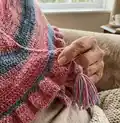
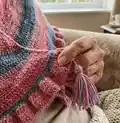
Ruffled By The Wind Pattern step 1 - construction progress Ruffled By The Wind Pattern step 2 - assembly progress Ruffled By The Wind Pattern step 3 - details and accessories Ruffled By The Wind Pattern step 4 - final assembly and finishing

Switch Things Up

I love how easy it is to customise this shawl by changing yarn colours β€” try a tonal main skein with a bold contrast mini for a pop of colour.

I often make a larger version by using a heavier yarn and bigger needles; adjust the number of repeat rows to get the wingspan you want.

I sometimes add tiny beads to the eyelet contrast band for a touch of sparkle; simply thread beads onto the yarn before working the row.

You could omit the contrast mini skein and work the entire shawl in one variegated yarn for a softer, blended look that still shows off the ruffle.

I like to play with the depth of the ruffle by repeating the doubling rows more times if I want a fuller, more dramatic edge.

For a delicate version, use a laceweight held with a fingering strand and a smaller needle to make a lightweight, airy shawl perfect for summer evenings.

Try adding a narrow knitted i-cord around the inner neck edge for a neat finish that makes the shawl easier to wear without pins.

I sometimes block the shawl into a gentle crescent rather than a pointed centre to get a different drape for casual wear.

If you prefer a triangular shawl, adjust the set-up tab and increase pattern to produce a classic triangle shape instead of a crescent.

I also enjoy turning this pattern into a mini triangle scarf by reducing repeats and using a mini skein to make a quick gift-size version.

Common Mistakes & How to Fix Them

βœ— Forgetting to pick up edge stitches when forming the set-up tab causes a lopsided start; turn and pick up the exact number of stitches as instructed to create an even foundation. βœ— Dropping yarnovers or failing to drop the yo when asked in contrast rows will mis-shape the eyelets; follow the instructions carefully to drop the indicated yo stitches when instructed for the correct effect. βœ— Not checking your work measurement before switching sections can shorten the shawl; repeat rows 3 and 4 until your work measures 17cm as specified before continuing. βœ— Blocking the ruffle edge flat will lose its effect; pin only under the eyelets and gently pull the centre of the ruffle down to maintain its shape when blocking.

Ruffled By The Wind Pattern

Make a delicate crescent-shaped shawl with a ruffled edge that blooms when blocked. This pattern is designed for fingering/4ply yarn and includes clear step-by-step row instructions for shaping and the ruffle finish. You will enjoy a versatile piece that can be worn many ways and finished to your taste. Suitable for knitters who know basic increases, yarnovers and simple shaping.

Intermediate 5-7 Hours

Materials Needed for Ruffled By The Wind Pattern

β€” Main Fabric

  • 01
    Family Tree Yarns 'Fiddle Tee Dee' fingering / 4ply, 100g/425m, 75% superwash merino, 25% nylon (main skein, approx 100g)
  • 02
    Family Tree Yarns 'This Charming Man' mini skein 20g/80m same yarn base (contrast mini skein)
  • 03
    Any fingering/4ply yarn of similar meterage approximately 425m total

β€” Tools Required

  • 01
    Needles 3.75mm US 5 (pair or circular for working flat)
  • 02
    Tapestry/yarn needle for weaving in ends
  • 03
    Scissors
  • 04
    Blocking pins
  • 05
    Measuring tape
  • 06
    Stitch markers (optional)
  • 07
    Pins for shaping when blocking

Progress Tracker

0% Complete

β€” Set Up Tab :

Round 1 :

Cast on 3 stitches

Round 2 :

Knit 6 rows

Round 3 :

Turn the work 90 deg and pick up and knit 3 stitches along the edge, one in each garter ridge.

Round 4 :

Turn the work another 90 deg and pick up and knit 3 stitches in the cast on edge. (9sts)

Info :

Now you have your starting stitches work the following..

β€” Main Body :

Round 1 :

Row 1. K1, k1m1, k5, k1m1, k1

Round 2 :

Row 2. K2, yo, k7, yo, k2

Round 3 :

Row 3. K2, k1, yo, knit to the last 3 stitches, yo, k1, k2

Round 4 :

Row 4. K2, k1m1, knit to the last 3 stitches, k1m1, k2

Info :

Repeat rows 3 and 4 until your work measures 17cm.

β€” Contrast Section :

Info :

Change to your contrast colour..

Round 1 :

Row 1. K2, k1, yo, (k1, yo) repeat bracket to the last 3 stitches, yo, k1, k2

Round 2 :

Row 2. K2, k1m1, k1, (p1, drop the yo stitch) repeat bracket to the last 4 stitches, k1, k1m1, k2

Round 3 :

Row 3. K2, k1, yo, knit to the last 3 stitches, yo, k1, k2

Round 4 :

Row 4. K2, k1m1, knit to the last 3 stitches, k1m1, k2

Round 5 :

Row 5. K2, k1, yo, knit to the last 3 stitches, yo, k1, k2

Round 6 :

Row 6. K2, k1m1, knit to the last 3 stitches, k1m1, k2

Round 7 :

Row 7. K2, k1, yo, (k1, yo) repeat bracket to the last 3 stitches, yo, k1, k2

Round 8 :

Row 8. K2, k1m1, k1, (p1, drop the yo stitch) repeat bracket to the last 4 stitches, k1, k1m1, k2

Round 9 :

Row 9. K2, k1, yo, knit to the last 3 stitches, yo, k1, k2

Round 10 :

Row 10. Return to main colour and work…. K2, k1m1, purl to the last 3 stitches, k1m1, k2

β€” Main Colour Rows :

Round 1 :

Now work the following.... Row 1. K2, k1, yo, knit to the last 3 stitches, yo, k1, k2

Round 2 :

Row 2. K2, k1m1, purl to the last 3 stitches, yo, k1, k2

Info :

Repeat these two rows another 7 times

β€” Contrast Ruffle Prep :

Info :

Change to contrast yarn and work….

Round 1 :

Row 1. K2, k1, Yo, (k1, yo) repeat bracket to last 3 stitches, yo, k1, k2

Round 2 :

Row 2. K2, k1m1, knit all stitches to last 3 stitches, k1m1, k2........this row is doubling your stitch count to begin making the ruffle edge.

β€” Ruffle Edge Work :

Info :

Change to main colour and work….

Round 1 :

Row 1. K2, k1, yo, knit to the last 3 stitches, yo, k1, k2

Round 2 :

Row 2. K2, k1m1, purl to the last 3 stitches, yo, k1, k2

Info :

Repeat these 2 rows once more.

β€” Increase Ruffle :

Round 1 :

Now work.... Row 1. K2, k1, Yo, (k1, yo) repeat bracket to last 3 stitches, yo, k1, k2

Round 2 :

Row 2. K2, k1m1, knit all stitches to last 3 stitches, k1m1, k2........this row is doubling your stitch count again

β€” Final Ruffle Repeats :

Round 1 :

Now work... Row 1. K2, k1, yo, knit to the last 3 stitches, yo, k1, k2

Round 2 :

Row 2. K2, k1m1, knit to the last 3 stitches, k1m1, k2

Info :

Repeat the above 2 rows a further 4 times.

Round 3 :

Then work next row… K2, k1, yo, knit to the last 3 stitches, yo, k1, k2

Round 4 :

Then cast off all the stitches

β€” Finishing :

Info :

Sew in the loose ends and the shawl will need to be blocked…..however don’t block the ruffle edge by pulling it flat or you will loose the effect of the ruffle.

Info :

I placed the pins just under the eyelets in the contrast section and pulled the centre of the ruffle down to give a finishing point, as can be seen in the photo below…you can choose not to do this and leave the edge rounded.

Info :

The shawl measures approx. 113cm wingspan by 34cm when blocked into a point.

Assembly Instructions

  • Sew in the loose ends using a tapestry needle and weave them into the wrong side to secure them before blocking.
  • Block the shawl by pinning the crescent shape into place; place pins just under the eyelets in the contrast section and gently pull down the centre of the ruffle to create the pointed finish.
  • Do not stretch or pin the ruffle edge flat; pin under the eyelets and allow the ruffle to keep its shape to preserve the effect.
  • Ensure the centre point is positioned symmetrically when pinning so the wingspan is even on both sides before leaving the shawl to dry.

Important Notes

  • πŸ’‘Use a consistent tension throughout to keep the crescent shaping even and to match the specified measurements.
  • πŸ’‘Measure your work to 17cm before changing to the contrast section to maintain the intended proportion of the design.
  • πŸ’‘When making the ruffle edge, be careful to follow the doubling rows exactly so the ruffle forms correctly without gaps or runs.

This shawl pattern celebrates hand-dyed yarn and simple shaping to make something truly special. It is perfect for gifting or adding a feminine touch to your wardrobe with a playful ruffle edge. The instructions are clear and adaptable, allowing you to personalise color and size choices. 🧢✨

You ask,

we answer.

FAQs

What size will the finished piece be?

The shawl measures approximately 113 cm wingspan by 34 cm when blocked into a point using the recommended yarn and needle size.

Can I use different yarn weights for this pattern?

Yes, you can use different yarn weights but your finished size and ruffle effect will change; use appropriate needles and swatch to check the result.

Do I need prior knitting experience for this pattern?

This pattern is rated intermediate, so familiarity with yarnovers, basic increases (k1m1) and picking up stitches is recommended.

How long does this project typically take to complete?

Most knitters finish this shawl in 5-7 hours, though time will vary with experience, yarn choice and how much time you spend blocking.