🧶 Beautiful ✨ Detailed 💝 Adorable

Pearodactyl Amigurumi Pattern

Pearodactyl Amigurumi Pattern
4.7★ Rating
5-7 Hours Time Needed
2.2K Made This
✂️

Intermediate Level

Ideal for those with basic crochet experience, featuring slightly more advanced stitches and techniques to expand your skills.

⏱️

Weekend Treat

Takes 5-7 hours, making it an enjoyable project to finish over a couple of days.

🐰

Whimsical Buddy

Playful characters full of personality, designed to spark imagination and become cherished playtime favorites.

About This Pearodactyl Amigurumi Pattern

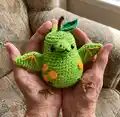
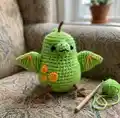
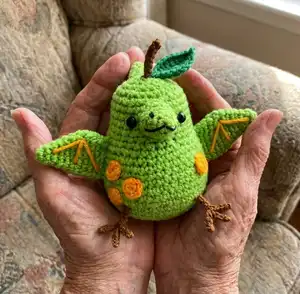
This pattern creates a small pear-shaped amigurumi called the Pearodactyl with tiny wings, a crest, a stem and leaf, and decorative spots. It uses DK weight yarn and small hook sizes to achieve neat, dense stitches and fine shaping. The instructions include invisible decreases and closing techniques so your finished piece looks professional and tidy.

Pearodactyl Amigurumi Pattern crochet pattern - detailed view of completed project

Perfect for makers who enjoy small, detailed toys with personality and character. The finished toy measures approximately 11cm tall using the suggested yarn and hook.

Why You'll Love This Pearodactyl Amigurumi Pattern

I absolutely love this pattern because it mixes playful design with compact, satisfying construction that you can finish in a weekend. I enjoy the way the pear shape gives the character so much charm while the small wings and spots let you add personality with color. I also love that the pattern teaches invisible decreases and closing techniques which produce a clean finish I am proud of. Making the little crest and beak is a fun detail that turns a simple shape into a memorable toy.

Pearodactyl Amigurumi Pattern step 1 - construction progress Pearodactyl Amigurumi Pattern step 2 - assembly progress Pearodactyl Amigurumi Pattern step 3 - details and accessories Pearodactyl Amigurumi Pattern step 4 - final assembly and finishing

Switch Things Up

I love customizing this Pearodactyl by switching colors; try a pastel palette for a softer, nursery-friendly friend.

Want it spooky? Use grey and dark green yarns and embroider tiny fangs for Halloween flair.

I often change yarn weight and hook size to create a mini keychain or a larger cuddle toy—swap DK for fingering or aran and adjust fillings accordingly.

I like adding tiny felt accessories like a mini scarf or hat to give each Pearodactyl a unique personality.

Try adding wire to the wings or legs if you want posability; insert thin floral wire and secure it inside with extra stuffing.

Swap safety eyes for embroidered eyes to make the toy baby-safe and machine-wash friendly.

Experiment with textures: use a boucle or wool blend for a rustic, fuzzy finish that changes the character completely.

Embroider different spot shapes or add stripes to the body for a more graphic, modern look.

I sometimes make a whole family by altering sizes—use leftover yarns to make sibling Pearodactyls with matching or contrasting spots.

For gifting, stitch on a tiny loop at the top of the stem and turn the toy into an ornament or bag charm.

If you like embellishments, sew on small felt leaves or a little ribbon bow at the base of the stem to dress your creation up.

Mix and match the Sunshine spots with metallic thread for a subtle sparkle detail that catches the light.

Common Mistakes & How to Fix Them

✗ Placing safety eyes too late can make positioning difficult; insert and check eye placement between rounds 24 and 25 so they are five visible stitches apart and symmetric. ✗ Over or under stuffing will distort the pear shape; stuff gradually as you go, adding small amounts during the decrease rounds to keep an even, rounded silhouette. ✗ Skipping invisible decreases will leave visible gaps in the fabric; use the described invisible decrease technique working in the FLO to keep decreases neat and hidden. ✗ Not counting stitches after increases or decreases leads to shape errors; count at the end of each round, especially after shaping rounds, to ensure you have the correct stitch total. ✗ Sewing parts without pinning can result in crooked features; pin or baste pieces in place and check positions against the photos before permanently sewing.

Pearodactyl Amigurumi Pattern

Create a whimsical Pearodactyl — a pear-shaped little dragon-pterodactyl hybrid — with this complete crochet pattern. You will be guided through shaping, tiny wings, a crest, and adorable spots so your finished toy has loads of personality. The pattern includes all materials, stitch abbreviations, step-by-step rounds, and assembly instructions so you can make a charming handmade gift.

Intermediate 5-7 Hours

Materials Needed for Pearodactyl Amigurumi Pattern

— Main Fabric

  • 01
    Stylecraft Special DK (DK weight) - Kelly Green
  • 02
    Stylecraft Special DK (DK weight) - Grass Green
  • 03
    Stylecraft Special DK (DK weight) - Sunshine
  • 04
    Stylecraft Special DK (DK weight) - Gingerbread

— Tools Required

  • 01
    Crochet hook size 2.5 mm
  • 02
    Two 6mm safety eyes
  • 03
    Stitch markers
  • 04
    Yarn needle
  • 05
    Fibrefill (polyester stuffing)
  • 06
    Black embroidery thread
  • 07
    Scissors
  • 08
    Pins for assembly (optional)

Progress Tracker

0% Complete

— Techniques :

Info :

How to close amigurumi invisibly 1. Insert needle in the FLO of each stitch around 2. Pull tight to close 3. Insert needle through centre exiting a few rounds down 4. Weave in the end and admire your work!

Info :

How to decrease invisibly 1. Insert hook into FLO of first stitch 2. Insert hook into FLO of next stitch 3. Yarn over and pull through two loops 4. Yarn over and pull through two loops again. Invisible decrease complete!

Info :

How to fold and stitch together 1. Fold piece in half, insert hook through next stitch and corresponding stitch on the other side 2. Yarn over and pull through both stitches 3. Complete sc as normal and repeat for all stitches 4. Finished piece folded and stitched together!

— Body :

Rnd 1 :

6sc in MR (6)

Rnd 2 :

inc each st around (12)

Rnd 3 :

*1sc, inc* rep 6 times (18)

Rnd 4 :

*2sc, inc* rep 6 times (24)

Rnd 5 :

*3sc, inc* rep 6 times (30)

Rnd 6 :

*4sc, inc* rep 6 times (36)

Rnd 7 :

*5sc, inc* rep 6 times (42)

Rnd 8 :

*6sc, inc* rep 6 times (48)

Rnd 9 - 16 :

sc each st around (48) (8 rnds)

Rnd 17 :

*6sc, dec* rep 6 times (42)

Rnd 18 :

sc each st around (42)

Rnd 19 :

*5sc, dec* rep 6 times (36)

Rnd 20 :

sc each st around (36)

Rnd 21 :

*4sc, dec* rep 6 times (30)

Rnd 22 - 27 :

sc each st around (30) (6 rnds)

Info :

Insert safety eyes between rnds 24 - 25 five visible sts apart.

Info :

Start adding stuffing and continue to stuff as we decrease.

Rnd 28 :

*3sc, dec* rep 6 times (24)

Rnd 29 :

*2sc, dec* rep 6 times (18)

Rnd 30 :

*1sc, dec* rep 6 times (12)

Rnd 31 :

dec 6 times (6)

Info :

Fasten off and leave a long tail. Complete invisible close. Weave in ends. (photo 1)

— Wings :

Info :

Make two

Rnd 1 :

6sc in MR (6)

Rnd 2 :

sc each st around (6)

Rnd 3 :

*sc, inc* rep 3 times (9)

Rnd 4 :

sc each st around (9)

Rnd 5 :

*2sc, inc* rep 3 times (12)

Rnd 6 :

sc each st around (12)

Rnd 7 :

*3sc, inc* rep 3 times (15)

Rnd 8 :

sc each st around (15)

Rnd 9 :

dec, 5sc, inc, 5sc, dec (14)

Rnd 10 :

dec, 4sc, 2inc, 4sc, dec (14)

Info :

Fold and stitch together. Cut yarn leaving a long tail.

Info :

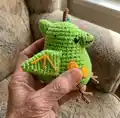
Using sunshine make three long sts on each wing making sure they are only visible on the front (photo 2)

— Crest :

Rnd 1 :

6sc in MR (6)

Rnd 2 :

*sc, inc* rep 3 times (9)

Rnd 3 :

sc each st around (9)

Rnd 4 :

*2sc, inc* rep 3 times (12)

Rnd 5 :

sc each st around (12)

Rnd 6 :

5sc, 2inc, 5sc (14)

Rnd 7 :

sc each st around (14)

Info :

Cut yarn leaving a long tail.

— Beak :

Rnd 1 :

6sc in MR (6)

Rnd 2 :

*sc, inc* rep 3 times (9)

Rnd 3 :

sc each st around (9)

Rnd 4 :

3sc, 3inc, 3sc (12)

Rnd 5 :

5sc, 2inc, 5sc (14)

Info :

Cut yarn leaving a long tail.

Info :

Using black embroidery floss, stitch two nostrils and a mouth to the beak. Crest and beak shown in (photo 3)

— Legs (make two) :

Info :

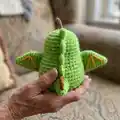
Using Gingerbread Ch8, *slst in 2nd ch from hook, 2slst, ch4* rep 2 times. Slst in 2nd ch from hook, 2slst, now working back up the original ch, 4slst. Cut yarn leaving a long tail (photo 4)

— Stem :

Info :

Using Gingerbread Ch7, slst in 2nd ch from hook, 5slst (6)

— Leaf :

Rnd 1 :

Using Kelly Green ch10, sc in 2nd ch from hook, 2hdc, dc, dcinc, dc, 2hdc, work the following sts in the final st (sc, ch2, slst in 2nd ch from hook, sc)

Info :

Now working down the other side of the ch, 2hdc, dc, dcinc, dc, 2hdc, sc, slst to join (20)

Info :

Cut yarn leaving a long tail. Stem and leaf shown in (photo 5)

— Spots (make five) :

Rnd 1 :

Using Sunshine 6sc in MR, slst to join

Info :

Cut yarn leaving a long tail (photo 6)

— Assembly :

Info :

We will use the long tails to attach everything to the body. Lightly stuff the beak then sew between the eyes over rnds 23 - 27 (photo 7). Lightly stuff the crest then sew to the back of the head directly opposite the beak over rnds 26 - 30 (photo 7). Attach the stem and leaf to the centre/top of head (photo 8). Join the wings either side of the body over rnds 15 - 21 (photo 9). Attach the legs between rnds 11 - 12 approx 10 sts apart (photo 9). Finally, sew the spots to the sides near each wing, three on one side, two on the other (photos 10 and 11).

Assembly Instructions

  • Lightly stuff the beak then sew it between the eyes over rounds 23 - 27 using the long tail for attachment and secure with hidden stitches (photo 7).
  • Lightly stuff the crest then sew it to the back of the head directly opposite the beak over rounds 26 - 30, aligning the crest centrally (photo 7).
  • Attach the stem and leaf to the centre/top of the head using the long tails and secure with several stitches so they sit upright (photo 8).
  • Join the wings to either side of the body over rounds 15 - 21, making sure the front of the wing faces forward and stitch securely through the body fabric (photo 9).
  • Attach the legs between rounds 11 - 12, spacing them approximately 10 stitches apart for balance and sew firmly through several rounds so they are stable (photo 9).
  • Sew the five spots to the sides near each wing using long tails: three on one side and two on the other, arranging them as shown in photos 10 and 11.

Important Notes

  • 💡Use stitch markers to mark the start of each round so you do not lose track during shaping and decreases.
  • 💡Insert safety eyes before closing the head fully to ensure correct placement and secure firmly with washers.
  • 💡Stuff gradually and evenly while shaping; overstuffing can distort shaping, and understuffing will cause flat areas.
  • 💡Weave in ends neatly and use invisible closing techniques to achieve a professional finish on the base and top.
  • 💡Pin pieces in place before sewing to check symmetry and alignment with the photos for accurate assembly.

Bring this silly little Pearodactyl to life with bright DK yarn and tiny details that make it unique. 🧶 Whether as a gift or a shelf friend, it delights with a pear-shaped body, little wings, and cheeky spots. 🍐🧵 Happy crocheting — enjoy the small, joyful process of stitching this whimsical buddy!
You ask,

we answer.

FAQs

What size will the finished piece be?

If made using the suggested yarn and hook size, the finished product is approximately 11cm tall.

Can I use different yarn weights for this pattern?

Yes, you can use different yarn weights, but your finished size will change; use an appropriate hook for the yarn and expect to adjust stuffing and details.

Do I need prior crochet experience for this pattern?

This pattern is rated intermediate, so basic knowledge of single crochet, increases, decreases, and working in the round is recommended.

How do I make decreases less visible?

Use the invisible decrease method described in the techniques section—work decreases in the front loop only and follow the step-by-step instructions for a neat finish.

How should I attach the wings and spots for best placement?

Pin the wings to rounds 15-21 and the spots near each wing, three on one side and two on the other, then stitch using the long tails to secure their positions.