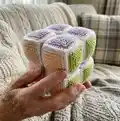
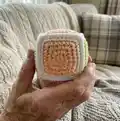
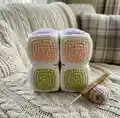
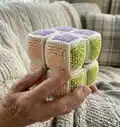
About This Infinity Cube Amigurumi Pattern
This pattern teaches you to crochet colorful squares and join them into soft, twistable Infinity Cubes. You will make 48 squares in six colors and edge them in white to form eight small cubes. The design focuses on simple shaping, neat seams and an assembly method that creates a dynamic fidget toy.
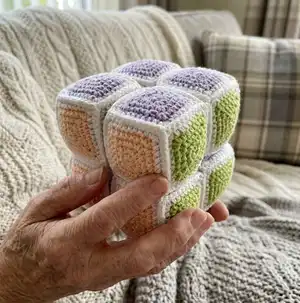
Clear rounds and photo instructions guide you through each step from squares to finished toy. The finished cube measures approximately 10 cm using the suggested materials.
Why You'll Love This Infinity Cube Amigurumi Pattern
I absolutely love this pattern because it transforms basic crochet squares into a clever, tactile fidget toy that is both playful and soothing. I enjoy how the color combinations bring personality to each cube and how the simple assembly creates surprising movement. The pattern is satisfying to make from start to finish—you see progress quickly as you complete each square and cube. I find it a wonderful gift idea for kids or adults who appreciate handmade sensory toys, and I love that you can customize it endlessly.
Switch Things Up
I love how many ways you can customize this Infinity Cube: change the color palette to match a nursery, use bright primary colors for kids, or go monochrome for a stylish adult fidget toy.
If you want a larger or smaller cube, switch yarn weight and hook size—use bulky yarn with a larger hook for a chunky version or fine cotton with a small hook for mini keychain cubes.
I often add embroidered symbols or small appliques to the center square for personalization, like initials, stars or hearts to make each cube unique.
Try altering the texture by substituting some rounds with half double crochet (hdc) or front loop only (FLO) rows to create contrasting ridges that feel nice to touch.
For an extra tactile experience, insert a small bell or rattle before final closing to make a sensory version for babies or toddlers, ensuring the item is age-appropriate and safely enclosed.
Want a more durable toy? Use mercerized cotton and tighter tension, and reinforce seams with an extra pass of stitching along join lines to withstand heavy handling.
I sometimes make a set of three cubes in coordinating colors and attach them with a removable clip so they can be played with together or separated as single fidgets.
Consider using variegated yarn for the colored squares so each face has a different shading, creating a subtle, fascinating look when you twist the cube.
Embellish with small felt shapes sewn onto faces after assembly for a soft contrast, or add a contrast border instead of white to change the visual emphasis.
If you enjoy mixed-media, try inserting thin flexible wire inside seams before final closing to add a slight poseable quality, but ensure ends are well secured and padded inside the stuffing.
Common Mistakes & How to Fix Them
✗ Skipping the chain (ch) counted as a stitch when counting rows leads to wrong stitch totals; always count the turning chain as instructed when tallying stitches.
✗ Overstuffing the cube causes the sides to bulge and deform the shape; fill the cube lightly and shape it by hand after assembly to keep neat edges.
✗ Failing to secure and hide thread tails leaves bulky seams and loose ends; fasten off carefully and hide ends inside the cube using a yarn needle.
✗ Rushing corner joins without using the additional slip stitch makes the corner look rounded; when joining, make the extra sl st through the corner sc to sharpen each corner.
✗ Not aligning color faces consistently when assembling parts will produce mismatch in the final toy; follow the assembly photos and orientation notes to keep faces directed the same way.