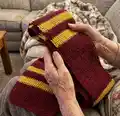
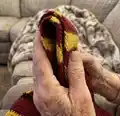
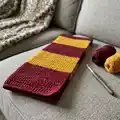
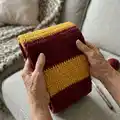
About This Hogwarts House Scarf Pattern
This pattern creates a long, circular Hogwarts house scarf worked in the round with alternating dark and light stripes. It includes instructions for house color choices (Gryffindor, Slytherin, Ravenclaw, Hufflepuff) and a simple method for adding fringe tassels. The scarf is designed to be warm, wearable, and easy to customize.
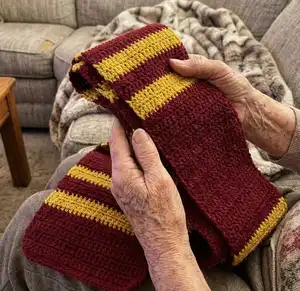
Worked on short circular needles, the tube-style scarf is knit in the round for a seamless finish. Stripes are formed by knitting 22 rows in each color, producing bold banding approximately 3 inches long.
Why You'll Love This Hogwarts House Scarf Pattern
I absolutely love this pattern because it combines straightforward knitting techniques with bold, iconic colorwork that makes a real statement. I enjoy how quickly the stripes build up—22-row bands give a satisfying rhythm to the knitting. The finished cowl is both cozy and versatile, perfect for everyday wear or as a thoughtful handmade gift. I also love the simple fringe finishing method; it transforms the tube into a polished, finished scarf with a little extra personality.
Switch Things Up
I love how easy it is to customize this pattern — try swapping house colors to make a set of scarves for friends.
If you want a chunkier look, use bulkier yarn and larger circular needles to make a warm, plush version that works up faster.
For a mini or child-sized cowl, use a finer yarn and smaller needles and reduce the cast-on to fit smaller neck measurements.
I often change the stripe width by knitting 11 rows of each color instead of 22 for a subtler striping effect; it shortens the stripes and creates a different rhythm.
Consider embroidering a small house initial or crest using duplicate stitch after blocking for a personalized touch.
To make a flat traditional scarf, knit the same stitch count flat on straight needles instead of joining in the round and add fringe at both ends.
Experiment with ombre or gradient yarns for the MC and a solid CC to create a softer transition between stripes.
I sometimes add a thin metallic strand held with the MC for a subtle sparkle on special occasion scarves.
Vary your tassel length or use braid instead of tassels for a neater finish; you can also add pom-poms for a playful alternative.
If you want a reversible look, carry the unused color up the inside of the tube and pick up the float periodically to hide ends, but be mindful of tension changes.
Common Mistakes & How to Fix Them
✗ Joining the round too tightly can create a visible seam or twist; before joining, ensure your cast-on edge is not twisted and place the marker loosely to allow the stitches to settle.
✗ Carrying the contrast color incorrectly will cause puckering at the color join; tie the CC around the inside of the tube as instructed and leave matching tails to secure and weave in later.
✗ Not counting your 22-row stripes can lead to the wrong number of stripes; mark every 22nd row with a separate marker or keep a row counter to ensure you reach ten dark and nine light stripes.
✗ Skipping blocking will leave uneven width along the scarf; block the scarf width-wise and gently stretch it until the entire piece is the same width to achieve a professional finish.
✗ Making fringe pieces inconsistent in length makes the ends look messy; measure your fringe using a 7.5 inch book or cardboard template and cut all pieces to the same length before assembling tassels.