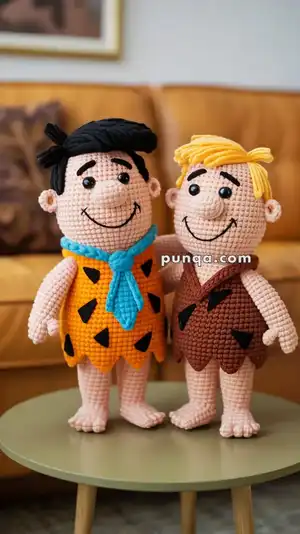
Create two lovable, display-ready amigurumi versions of Fred and Barney inspired by classic cartoon styling. This pattern produces two standing characters with sculpted heads, expressive embroidered faces, signature tunics (orange with blue tie and brown with collar), and chunky textured hair. Perfect for gifting or shelf decor, the pattern focuses on rounded shaping, sturdy construction, and charming facial details.
Progress Tracker
0% Complete
— General Notes :
Info :
This pattern describes one doll construction. Repeat full head/body/limbs to make both Fred and Barney. The only differences are yarn colors for tunics, hair color and tie vs collar details. Work in continuous rounds unless otherwise instructed; use a stitch marker to mark the first stitch of each round. Numbers in parentheses at the end of each round indicate total stitches for that round.
Info :
Gauge is not critical for likeness but is important to keep stuffing from showing: work tightly with a hook 1-2 sizes smaller than the yarn label suggests for bulky or chenille yarn. If using worsted yarn, reduce hook size accordingly.
— Head (Make 2 - identical shaping for Fred and Barney) :
Round 1 :
6 sc in magic ring (6)
Round 3 :
(1 sc, inc) x 6 (18)
Round 4 :
(2 sc, inc) x 6 (24)
Round 5 :
(3 sc, inc) x 6 (30)
Round 6 :
(4 sc, inc) x 6 (36)
Round 7 :
(5 sc, inc) x 6 (42)
Round 8 :
(6 sc, inc) x 6 (48)
Round 9-12 :
1 sc in each st (48)
Info :
Mark the center front stitch. Place stitch marker there to maintain orientation for nose and eye placement. Keep rounds 9-12 even to build height where eyes will be placed later.
Round 13 :
1 sc in each st (48)
Info :
Eye placement: Use safety eyes or embroider. For 12mm eyes place between rounds 13-14 approximately 10-12 stitches apart (count from center front marker to space eyes evenly). For a softer look you may embroider small circles instead.
Round 14-16 :
1 sc in each st (48)
Info :
If using safety eyes, insert washers before stuffing firmly. If embroidering, mark stitch positions now with pins or safety pins so you can stitch after initial stuffing. Place embroidery of smiling mouth position lower (rounds 10-11 area) later.
Round 17 :
(6 sc, dec) x 6 (42)
Round 18 :
(5 sc, dec) x 6 (36)
Info :
Begin stuffing head firmly but keep one hand to compress stuffing as you go. Use small tufts of fiberfill to avoid lumps and ensure even distribution, particularly around the cheeks where you want that round shape.
Round 19 :
(4 sc, dec) x 6 (30)
Round 20 :
(3 sc, dec) x 6 (24)
Info :
At this point sculpt nose location: three rounds above this decrease zone will be the base for the nose. If crocheting nose as a separate piece (recommended), now is a good time to make the nose and set aside to sew on later so you can check placement while stuffing.
Round 21 :
(2 sc, dec) x 6 (18)
Round 22 :
(1 sc, dec) x 6 (12)
Info :
Fasten off leaving long tail for sewing or continue to form neck directly into body depending on assembly preference. Finish stuffing through the neck with small amounts to keep head firm but not rock-hard. Set head aside if attaching later.
Round 24 :
Optional: For a longer neck, join yarn and work additional rounds: 1 sc in each st (6) for 3-5 rounds to form neck tube (adjust per doll height)
Info :
Neck length recommendation: 3 rounds for compact heads, 4-5 rounds for more separation between head and body. Add stuffing lightly to neck tube to retain shape.
— Nose (Make 2) :
Round 1 :
6 sc in magic ring (6)
Round 3 :
(1 sc, inc) x 6 (18)
Round 4 :
1 sc in each st (18)
Info :
Stuff nose lightly to keep it rounded but malleable. Shape with fingers to a slightly oblong form to mimic the sculpted nose visible in the image. Sew to center front of head across rounds 11-13 area (use pins to position first).
Round 5 :
(2 sc, dec) x 4, 2 sc (14) — optional shaping
Round 6 :
Work evenly 1 sc around (14) then fasten off leaving long tail for sewing
Info :
Sew nose using mattress stitch around base ensuring the bulbous end sits forward. Use extra thread to anchor firmly so nose will not flop when the doll is handled.
— Ears (Make 4; 2 for each doll) :
Round 1 :
6 sc in magic ring (6)
Round 3 :
1 sc in each st (12)
Round 4 :
BLO 1 sc in each st (12) to create a slight ridge for ear cup
Round 5 :
Fold ear in half and sc through both layers 6 times to close base, finish off leaving tail for sewing
Info :
Sew ears to head at rounds 9-11 on either side, approximate spacing: 10-12 stitches from center front. Ears are slightly cupped and should be sewn pointing slightly forward as seen in the photo.
— Eyes and Eyebrows :
Info :
Eyes: Use 10-12mm black safety eyes. Place eyes between rounds 13-14 and about 10-12 stitches apart depending on head circumference. If you prefer embroidered eyes for safety, use black yarn to stitch circles and highlight with a tiny white yarn dot for catchlight.
Info :
Eyebrows: Cut small felt pieces in an arched shape or embroider using black yarn. Position above eyes about 2 rounds up and secure with small stitches. For a thick cartoon look, felt pieces give a cleaner silhouette.
— Mouth Embroidery :
Info :
Use black embroidery floss or yarn to stitch a wide smiling mouth across rounds 10-12. Start with a guide marked with pins: the smile arcs from one cheek to the other and lifts slightly toward the nose. Use backstitch for a smooth curve. Add an additional short stitch at each corner to mimic the small creases visible in the dolls.
— Hair (Fred: Black Chunky Hair; Barney: Blonde Chunky Hair) :
Info :
Hair is constructed as a separate hair cap and tuft pieces. For chunky, plush hair use a slightly smaller hook than the yarn suggests to keep strands neat. Hair cap is a shallow dome sewn on top of head; individual tufts are looped strands or crocheted short strips sewn down for direction.
Hair Cap Round 1 :
6 sc in magic ring (6)
Hair Cap Round 2 :
6 inc (12)
Hair Cap Round 3 :
(1 sc, inc) x 6 (18)
Hair Cap Round 4 :
(2 sc, inc) x 6 (24)
Hair Cap Round 5 :
(3 sc, inc) x 6 (30)
Hair Cap Round 6-7 :
1 sc in each st (30)
Info :
Fasten off and leave long tail for sewing. Position cap to cover top/front of head leaving forehead clear for eyebrows. Sew in place with hidden stitches. Add tufts by looping strands through cap or sewing short crocheted strips over the cap to create the signature swoop and side pieces.
Tuft (Make many) Round 1 :
ch 8, sl st in 2nd ch from hook, sc across 6 (6) — fasten off leaving tail for sewing. Attach by sewing one end to cap and spreading strands across head.
Info :
Fred's hair is swept with a larger front swoop; use larger tufts and arrange layered. Barney's hair is shorter and lighter with small fringe pieces; attach more smaller tufts to achieve the look.
— Body (Make 2) :
Round 1 :
6 sc in magic ring (6)
Round 3 :
(1 sc, inc) x 6 (18)
Round 4 :
(2 sc, inc) x 6 (24)
Round 5 :
(3 sc, inc) x 6 (30)
Round 6-8 :
1 sc in each st (30)
Info :
If adding tunic/clothing, change to clothing color now or work clothing as separate skirt/tunic. For this pattern we crochet the basic torso in skin color and then add a removable tunic worked separately; this ensures crisp edges and easier sewing of details like black triangles.
Round 9 :
1 sc in each st BLO (30) — creates a ridge for tunic top when sewing or slipping tunic over body
Round 10-14 :
1 sc in each st (30)
Info :
Begin stuffing the torso lightly from the bottom in small increments so the stuffing nests inside without lumps. Keep a medium density so the doll sits stable but still has weight to stand when legs are attached.
Round 15 :
(3 sc, dec) x 6 (24)
Round 16 :
(2 sc, dec) x 6 (18)
Round 17 :
(1 sc, dec) x 6 (12)
Round 18 :
1 sc in each st (12)
Info :
Leave the top opening big enough to sew or insert the head. If you created a neck tube on the head, insert it into the body opening, pin to check alignment, then sew through the neck rounds and the body opening rounds using invisible ladder stitch for a neat finish.
Round 19 :
Fasten off leaving a long tail for attaching head. Finish stuffing the body firmly in the upper portion to support head weight.
— Tunic (Fred: Orange with scalloped hem and tie; Barney: Brown with collar) :
Info :
Tunics are worked separately then slipped or sewn over the body. Work from top down so the neckline sits over the torso ridge created by the body BLO round. Replace color names as applicable: orange/turquoise for Fred, brown for Barney.
Tunic Round 1 :
ch 30 (or adjustable to fit the 30-st torso circumference), sl st to join into ring — do not twist. Ensure your chain fits snugly over the torso at the neck.
Tunic Round 2 :
ch 1, sc in each ch around (30) — join with sl st to first sc; place marker for seam alignment (30)
Tunic Round 3-6 :
1 sc in each st (30)
Info :
To make a scalloped hem similar to the dolls, work increases and slip stitch clusters at the bottom. Keep tunic height about 8-10 rounds depending on doll proportion—longer tunic covers upper leg area like in the photo.
Tunic Round 7 :
(2 sc, inc) x 10 (40) — optional for a fuller tunic base
Tunic Round 8-10 :
1 sc in each st (40)
Tunic Round 11 (Scallop row) :
*skip 2 sts, 5 dc in next st, skip 2 sts, sl st in next st* rep around to form scallops — adjust repeats to match circumference
Info :
Sew black triangular felt pieces or crochet small black triangles and stitch them onto the tunic to recreate the spotted pattern. Place triangles evenly in 2-3 columns around the tunic as in the picture.
Fred Tie (Make 1) Round 1 :
ch 20, sc in 2nd ch from hook across (19), fasten off leaving tail for sewing. Fold narrow piece in half and join ends to create loop, then stitch one end to front of tunic and sew tie flap to create hanging tie look.
Barney Collar (Make 1) Round 1 :
ch 16, sl st to form loop, sc around for 2 rounds to make collar thickness, attach to tunic neckline and fold to create V-shaped collar, secure with hidden stitches.
Info :
Tunic edges can be sewn onto the body or left removable. For a clean look, slip tunic over the body and stitch at the shoulder rounds to keep it from sliding down.
— Arms (Make 4: 2 for each doll) :
Round 1 :
6 sc in magic ring (6)
Round 3 :
(1 sc, inc) x 6 (18)
Round 4-6 :
1 sc in each st (18)
Info :
These first rounds form the hand. Stuff the hand firmly to keep it rounded. If adding small fingers, see the finger shaping rounds below.
Round 7 :
1 sc in each st BLO (18) — creates wrist ridge
Round 8-10 :
1 sc in each st (18)
Info :
Change to body/skin color now if you are working a different yarn for hands; otherwise continue in same color. Keep arms lightly stuffed along length so they remain soft and flexible.
Round 11 :
(3 sc, dec) x 3 (15)
Round 12-15 :
1 sc in each st (15)
Round 16 :
(2 sc, dec) x 3 (12)
Round 17-18 :
1 sc in each st (12)
Round 19 :
(1 sc, dec) x 4 (8)
Round 20 :
1 sc in each st (8) — fasten off leaving long tail for sewing
Info :
Sew arms to sides of body at rounds 10-12 in the torso for a natural placement. Use ladder stitch to make the seam invisible and attach firmly so arms can be posed slightly forward as in the photo.
Optional Fingers :
For small finger details, work 3 tiny tubes: ch 4, sc in 2nd ch from hook and next two chs (3), fasten off leaving tail. Sew three tubes across the hand tip and flatten slightly to form thumb and two fingers for a simple mitten look.
— Legs (Make 4: 2 for each doll) :
Foot Round 1 :
6 sc in magic ring (6)
Round 3 :
(1 sc, inc) x 6 (18)
Round 4 :
(2 sc, inc) x 6 (24)
Round 5-6 :
1 sc in each st (24) — shape toe box by working these rounds slightly tighter
Info :
To make toes, pinch front of foot and work short chain-to-tube toes or sew in small ridges: use yarn to stitch across front creating three small toe separations as seen in the photo.
Round 7 :
1 sc in next 12 sts only (12) — this creates the sole front shaping; continue working back and forth in the round conceptually to build ankle tube (you will join in the round at the end of sequences)
Round 8-11 :
1 sc in each st (12) — ankle/lower leg
Round 12 :
(1 sc, inc) x 4 (16) — expanding into the calf
Round 13-18 :
1 sc in each st (16)
Round 19 :
(2 sc, inc) x 4 (20)
Round 20-24 :
1 sc in each st (20)
Round 25 :
Fasten off leaving long tail for sewing. Stuff feet firmly, and legs moderately so the doll stands. Sew legs to bottom of body at rounds 1-3 area and space evenly about 6-8 stitches apart for stability.
Info :
When attaching legs, place them so the dolls can stand upright. Add extra stuffing at the base of each foot to flatten slightly and create a stable standing surface. If desired, add a small disc of felt inside the sole before finishing for added stability.
— Assembly :
Info :
Before sewing parts together, pin everything in place and photograph for reference. Sew all limbs on securely with the long tails left for each piece. Reinforce attachment points with several passes of yarn to prevent wobbling.
Step 1 :
Attach head to body by inserting the neck portion into the body opening. Pin in place first, then sew securely using whip stitch or invisible ladder stitch all around, ensuring even attachment and correct forward tilt.
Step 2 :
Position arms on sides of body at torso rounds 10-12 for a natural look. Sew through both arm and body using ladder stitch for invisible seam. Attach arms angled slightly forward to match the image.
Step 3 :
Attach legs to bottom of body at rounds 1-3, spacing them evenly. Sew securely, adding extra stitches for stability if character will be posed frequently. Add a few running stitches up through the leg into the body to secure weight.
Step 4 :
Sew ears to top sides of head at rounds 9-11, spacing them about 10-12 stitches from center. Curve slightly forward and tack down firmly so they keep shape.
Step 5 :
Attach hair cap and tufts, sewing the cap to head starting at the crown and working forward. Lay tufts for each character to match signature styles and secure with tight stitches.
Step 6 :
Sew tunic pieces together and place over body. Sew at shoulder points if needed to secure. Add felt or crocheted triangles using tight whip stitch at evenly spaced intervals.
Step 7 :
Embroider the mouth using the marked guide, then add any facial detail such as dimples or eyebrow stitches. Double-check symmetry before final tying off.
Step 8 :
Secure any loose ends by weaving through several stitches and trimming close to work. If adding wire to limbs, ensure wire ends are wrapped and buried in stuffing or covered to prevent poking.
— Extra Decorative Details :
Info :
Black felt triangles: cut small isosceles triangles about 1 - 1.2 cm tall. Sew with small hidden stitches to tunic. For a cleaner look, apply fabric glue then tack stitch once dry. For more durable pieces, crochet small triangles using black yarn (ch 4, sc across, decrease to form triangle) and sew on.
Info :
Fred tie detail: work a small textured stitch (hdc or front post sc) for the tie to give it depth. Sew one end anchored under the neck and dangle the tie front piece as pictured.
Info :
Optional weighting: for a heavier, more display-friendly figure, insert a small sachet of beads at the bottom of the torso before final stuffing and closing. Keep weight even across legs to avoid tipping.
— Finishing Touches :
Info :
Use a small amount of black embroidery around mouth seams to refine the smile edges. Add a white yarn dot or painted catchlight to eyes if embroidered. Press felt triangles flat and make sure all seams are tidy.
Info :
Give your dolls a final check for loose ends and ensure all parts are secure. If gifting to a child, consider embroidering eyes rather than using safety eyes for full safety compliance.
Finishing these two character dolls is such a rewarding experience — they come together with bright tunics, cheeky smiles, and signature hair that make each one instantly recognizable! The pattern balances sculptural shaping with approachable techniques so you can enjoy every step of creation. Once complete, these dolls make wonderful nostalgic gifts or eye-catching shelf décor. 🧶😊 Share your finished pair and celebrate your hand-made success! 🎁