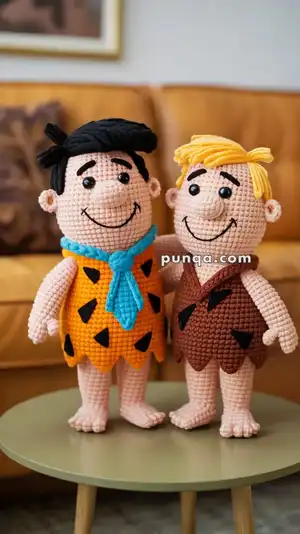
Fred & Barney Amigurumi Pattern
Capture the classic Flintstones charm with this detailed Fred & Barney amigurumi pattern. This set includes fully worked heads, bodies, limbs, hair styles, iconic tunics, and facial details so you can recreate both characters accurately. The pattern uses worsted weight yarn and safety eyes, with clear instructions for shaping, stuffing, and assembly. Perfect as a pair for display, play, or a nostalgic handmade gift.
Intermediate
8-10 Hours
Materials Needed for Fred & Barney Amigurumi Pattern
— Main Fabric
-
01
Worsted weight yarn (#4), approximately 160-180g in flesh/skin tone (light peach seen in image) for one doll; double for two dolls if making both at once
-
02
120-140g in orange (Fred tunic)
-
03
80-100g in brown (Barney tunic)
-
04
30-40g in black for hair, eyebrows, and tunic spots
-
05
30-40g in yellow/golden for Barney hair
-
06
30-40g in blue/turquoise for Fred tie/scarf
-
07
Small amounts (10-15g each) in white and dark brown for facial embroidery and shoe/toe accents
-
08
Optional: extra 20-30g of contrast color if making both dolls simultaneously
— Tools Required
-
01
3.5mm (E) crochet hook for main work (adjust for your tension)
-
02
3.0mm (D) hook for tighter facial details and small elements
-
03
2.5mm (C) hook for very small details (optional)
-
04
Safety eyes 10mm for adult display or 12mm for larger look (use size that suits your finished scale)
-
05
Polyester fiberfill stuffing
-
06
Yarn needle for sewing and embroidery
-
07
Stitch markers (at least 4)
-
08
Scissors
-
09
Pins for assembly
-
10
Row counter or notepad to track rounds
-
11
Optional: flexible floral wire or pipe cleaners for poseable limbs
-
12
Optional: fabric glue for securing pieces or small felt details
Progress Tracker
0% Complete
— Head (Base head for both dolls) :
Round 1 :
6 sc in magic ring (6)
Round 3 :
(1 sc, 1 inc) x 6 (18)
Round 4 :
(2 sc, 1 inc) x 6 (24)
Round 5 :
(3 sc, 1 inc) x 6 (30)
Round 6 :
(4 sc, 1 inc) x 6 (36)
Round 7 :
(5 sc, 1 inc) x 6 (42)
Round 8 :
(6 sc, 1 inc) x 6 (48)
Round 9 :
1 sc in each st (48)
Round 10 :
1 sc in each st (48)
Info :
Place safety eyes between rounds 13-14, approximately 9-11 stitches apart for the friendly expression. Mark the first stitch of each round using a stitch marker to avoid miscounts.
Round 11 :
1 sc in each st (48)
Round 12 :
1 sc in each st (48)
Round 13 :
1 sc in each st (48)
Round 14 :
1 sc in each st (48)
Info :
For eye placement: count across a row of 48 to find the center point - place each eye 5 or 6 stitches either side of center depending on size of eyes used. Lock eyes with washers before continuing to avoid shifting while stuffing.
Round 15 :
1 sc in each st (48)
Round 16 :
1 sc in each st (48)
Round 17 :
1 sc in each st (48)
Round 18 :
1 sc in each st (48)
Info :
If embroidering eyebrows and smile instead of felt pieces, plan placement now by using removable marker or pins. Begin light stuffing to shape the face slightly before nose is attached.
Round 19 :
(6 sc, 1 dec) x 6 (42)
Round 20 :
(5 sc, 1 dec) x 6 (36)
Info :
Begin stuffing head firmly at this stage, compressing lightly so facial features sit well. Add stuffing gradually after each decrease round to maintain round shape.
Round 21 :
(4 sc, 1 dec) x 6 (30)
Round 22 :
(3 sc, 1 dec) x 6 (24)
Round 23 :
(2 sc, 1 dec) x 6 (18)
Round 24 :
(1 sc, 1 dec) x 6 (12)
Info :
Fasten off leaving a long tail for sewing. Before completely closing, make sure nose and ears are attached (instructions below) and final facial embroidery is positioned. Finish stuffing firmly if needed then close and weave tail through remaining stitches to secure.
— Nose (Make 1) :
Round 1 :
6 sc in magic ring (6)
Round 3 :
(1 sc, 1 inc) x 6 (18)
Round 4 :
1 sc in each st (18)
Round 5 :
(2 sc, 1 dec) x 6 (12)
Round 6 :
1 sc in each st (12)
Info :
Stuff lightly to create a bulbous nose. Leave a long tail and position on face centered between the eyes and about 3-4 rounds below them. Sew onto head firmly with ladder stitch to create the prominent rounded bridge pictured.
— Ears (Make 2) :
Round 1 :
6 sc in magic ring (6)
Round 2 :
inc in each st (12)
Round 3 :
1 sc in each st (12)
Round 4 :
1 sc BLO around (12)
Round 5 :
(1 sc, dec) x 4 (8)
Round 6 :
1 sc in each st (8)
Info :
Pin ears to the head at rounds 12-15, approximately 10-12 stitches from centerline on either side. Slightly fold and stitch the base to create a rounded ear cup. Use small whip stitches to attach and ensure mirroring.
— Facial Features & Embroidery :
Info :
Use black embroidery thread or thin yarn for the smile and eyebrow details. For the smile: using a yarn needle, stitch an even arc starting about 2 stitches below the nose spanning roughly 18-22 stitches. Tighten gently so the curve sits naturally. For eyebrows: place above the eyes, two short curved stitches each, about 2-3 stitches long.
Info :
To make the dimples/cheek curves seen on the dolls, add two short curved lines from the ends of the smile upwards towards the cheeks. You can use a split stitch for a smooth embroidered line.
— Body (Make 1 per doll) :
Round 1 :
6 sc in magic ring (6)
Round 3 :
(1 sc, 1 inc) x 6 (18)
Round 4 :
(2 sc, 1 inc) x 6 (24)
Round 5 :
(3 sc, 1 inc) x 6 (30)
Round 6 :
(4 sc, 1 inc) x 6 (36)
Round 7 :
(5 sc, 1 inc) x 6 (42)
Round 8 :
(6 sc, 1 inc) x 6 (48)
Round 9-12 :
1 sc in each st (48)
Info :
If adding tunic clothing that starts at the chest, change to clothing color now or later depending on whether you prefer to sew the tunic on separately. Working the clothing in BLO for one round creates a subtle ridge for the neck line.
Round 13 :
1 sc in each st BLO (48)
Round 14-16 :
1 sc in each st (48)
Round 17 :
(6 sc, 1 dec) x 6 (42)
Round 18 :
(5 sc, 1 dec) x 6 (36)
Info :
Begin stuffing body moderately at round 16-17; keep it firmer at the bottom to help dolls stand. Leave the top opening wide enough to insert the neck of the head for sewing.
Round 19 :
(4 sc, 1 dec) x 6 (30)
Round 20 :
1 sc in each st (30)
Round 21 :
(2 sc, 1 dec) x 6 (24)
Round 22 :
(1 sc, 1 dec) x 6 (18)
Round 23 :
1 sc in each st (18)
Round 24 :
(1 sc, 1 dec) x 6 (12)
Info :
Fasten off leaving a long tail for sewing. When attaching the head, insert the neck opening into the body top and sew evenly around to prevent wobble. Add a little extra stuffing if required to create a snug neck joint.
— Arms (Make 2 per doll) :
Round 1 :
6 sc in magic ring (6)
Round 3 :
(1 sc, 1 inc) x 6 (18)
Round 4-5 :
1 sc in each st (18)
Info :
These initial rounds form the hand. Decide finger shaping now: these dolls have simple tapered hands with small thumb shaping. Stuff hand firmly but not overpacked to allow a flat sew-in surface.
Round 6 :
(2 sc, 1 dec) x 6 (12)
Round 7-10 :
1 sc in each st (12)
Round 11 :
(1 sc, 1 inc) x 6 (18)
Round 12-15 :
1 sc in each st (18)
Info :
To create a slight arm curve like the photo, stuff lower arm more densely and upper arm a bit lighter. If you prefer poseable arms, insert a short length of floral wire before finishing stuffing; ensure ends are secured and wrapped.
Round 16 :
(2 sc, 1 dec) x 6 (12)
Round 17 :
1 sc in each st (12)
Round 18 :
Fasten off leaving long tail for sewing. Fold opening flat and sew to body at rounds 18-21 on the body, spacing arms symmetrically on either side.
— Fingers (Optional decorative, 3 small bumps per hand) :
Info :
To make the small finger bumps shown, make 3 tiny bumps by chaining 2, sc in second chain, sl st back into the hand top where you'd like the fingers. Whipstitch across three tiny bumps on the hand edge. Alternatively embroider small separations with thin yarn for toes and fingers look.
— Legs (Make 2 per doll) :
Round 1 :
6 sc in magic ring (6)
Round 3 :
(1 sc, 1 inc) x 6 (18)
Round 4 :
(2 sc, 1 inc) x 6 (24)
Round 5-7 :
1 sc in each st (24)
Info :
Work foot shaping in rounds 1-7; flatten slightly at the sole area when stuffing to create a stable base for standing. Use denser stuffing in the toes and sole.
Round 8 :
(3 sc, 1 inc) x 6 (30)
Round 9-13 :
1 sc in each st (30)
Round 14 :
(4 sc, 1 dec) x 5 (25)
Round 15 :
1 sc in each st (25)
Round 16 :
(2 sc, 1 dec) x 5 (20)
Round 17-20 :
1 sc in each st (20)
Round 21 :
(1 sc, 1 dec) x 6 + 2 sc (14)
Round 22 :
1 sc in each st (14)
Info :
Stop stuffing when leg shaft is about half full; add more stuffing to foot area for weight. Leave a long tail for sewing; attach legs to bottom of body at the spacing recommended in assembly notes so dolls stand evenly.
— Toes (Make 5 per foot, worked in place) :
Round 1 :
From the sole edge, ch 2, sc in 2nd ch, sl st back into foot to form a tiny bump; repeat for 5 toes spaced evenly across front of foot.
Info :
Use small slip stitch bumps and a few surface stitches to define toes as in photo. Sew or embroider small lines to accentuate toe separation.
— Hair - Fred (Black pompadour) :
Info :
Fred has a thick pompadour with a side swoop and small back tufts. This is worked as several flat pieces sewn to the scalp then shaped with surface loops and short rows of slip stitches to create volume.
Piece A - Top Pompadour Round 1 :
ch 12, sc in 2nd ch from hook and across (11)
Round 2-4 :
ch1, turn, sc across (11) - make 3 rows total
Round 5 :
dec at each end: sc2tog, sc across until last 2 sts, sc2tog (9)
Info :
Make 3-4 overlapping flat panels of varying widths (11,9,7 stitches) to layer for the pompadour and sew them centered over the forehead. Use surface slip stitching to create the deep fold lines seen in the image.
Piece B - Side Tufts (Make 2) Round 1 :
ch 6, sc across (5)
Round 2 :
ch1, turn, sc across (5)
Info :
Sew these to the sides of the head near the temples and use a needle to slightly pull the yarn to create angled tufts. Trim or cut loops to sculpt a smooth short hair appearance.
Piece C - Back Tufts (Make 2) :
ch 8, sc across, 2 rows, sew to crown back. Fluff and shape.
Info :
Secure all hair pieces with tight whip stitches. You can add a few stitches through the scalp into the backing to keep hair panels from lifting.
— Hair - Barney (Blond short fringe) :
Info :
Barney has short straight fringe with a few separate longer strands. Work short loops or single strands tied and sewn to the scalp to create a layered fringe.
Round 1 :
Cut lengths of yarn about 5 cm long. Fold in half, use a latch hook method to attach strands along the forehead in rows. Attach 5-6 strands per row to achieve visible thickness.
Round 2 :
For longer side strands, attach 6-8 cm lengths and trim to shape. Arrange a small loop tuft at the crown to add a playful spike.
Info :
Comb lightly with fingers and trim to match the short tidy look pictured. Use black yarn for a few accent hairs if desired for contrast.
— Tunic - Fred (Orange with scalloped hem and black triangles) :
Info :
Fred's tunic is a separate garment worked from the top down to create a sleeveless dress that fits snugly over the body. Work in rounds to desired chest circumference and create a scalloped hem by working shell stitches. Add black felt or crocheted triangles later for spots.
Round 1 :
With orange yarn, ch 40 and join to form a loop that fits around the chest (adjust to match doll chest circumference). Mark the join as rnd 1 (40)
Round 2-6 :
1 sc in each ch around (40)
Info :
Try the tunic on the body periodically to ensure proper fit at neckline and armholes. If creating a neckline overlap or V, leave a gap at the front and create a small front opening.
Round 7 :
1 sc in each st BLO (40)
Round 8-10 :
1 sc in each st (40)
Round 11 :
Work scalloped hem: *skip 2 sts, 5 dc in next st, skip 2 sts, sl st in next* rep around. Adjust shells to create twelve scallops (approx) and join (40)
Info :
Number of shells depends on your initial chain. Ensure scallops fall evenly around the hem; you can adjust by adding or subtracting a sc between shells.
Round 12 :
Fasten off. Cut 8 small triangles from black felt or crochet small black triangles (instructions below) and sew evenly onto front and back of tunic to match reference image.
Black Triangle - Felt or Crochet :
For crochet: ch4, sl st to form a small loop, rnd1: ch1, 3 sc in loop (3), rnd2: (1 sc, inc) x1 + 1 sc (4) - fasten off and flatten into triangle shape. Make 8 triangles.
Info :
Sew triangles securely with matching black thread and tuck ends under to hide raw edges. If using felt, use fabric glue plus a few stitches for durability.
— Tunic - Barney (Brown with scalloped hem and black triangles) :
Round 1 :
With brown yarn, ch 36 and join to form a loop to fit around chest (36)
Round 2-5 :
1 sc in each ch around (36)
Round 6 :
1 sc in each st BLO (36)
Round 7-9 :
1 sc in each st (36)
Round 10 :
Scalloped hem: *skip 2 sts, 5 dc in next st, skip 2 sts, sl st in next* rep around to create 9-10 scallops
Round 11 :
Fasten off. Add 3-4 black triangles on front similar to Fred but fewer and larger for proportion.
Info :
You can make tunics removable by leaving an opening at the back and stitching on a small snap or button, or simply sew them closed for a neater finish when making for display rather than play.
— Tie/Scarf - Fred (Make 1) :
Round 1 :
ch 30, join to work in rnds or keep flat depending on preferred look (30)
Round 2-4 :
1 sc in each st (30)
Round 5 :
Fold one end to create the knot: work 6 sc across the folded edge in FLO to create thickness, finish and shape a pointed tie end by decreasing 1 sc every other stitch across next 3 rows until point forms
Info :
Sew tie around the neck and tuck under tunic collar; secure with small stitches so it sits centered. For the textured knot shown, tie a small fabric knot and sew it to the tie to hold shape.
— Assembly Instructions :
Info :
Follow assembly steps carefully to ensure stable, balanced dolls. Pins will help keep pieces symmetrical and in the right orientation while sewing.
Round 1 :
Attach head to body by inserting the neck portion into the body opening. Pin in place first, then sew securely using whip stitch all around, ensuring even attachment.
Round 2 :
Position arms on sides of body at rounds 16-18 for a natural look. Sew through both arm and body using ladder stitch for invisible seam, ensuring the front of the arm aligns with the front of the body.
Round 3 :
Attach legs to bottom of body at rounds 1-3 of the base opening, spacing them evenly about 6-8 stitches apart depending on your body circumference. Sew securely, adding extra stitches for stability if the doll will be posed often.
Round 4 :
Sew ears to top sides of head at rounds 11-14, spacing them 10-12 stitches apart. Curve them slightly forward for a natural appearance and stitch the base down to create the cup shape of the ear.
Round 5 :
If attaching hair panels, layer panels from back to front and tack each down with small, tight stitches. For Fred, center the largest pompadour panel and overlay the smaller ones to form the sweep across the forehead.
Round 6 :
Attach tunic by sliding over the body or sewing it to the chest area at rounds 8-12. If tunic is separate, stitch a few small stitches at shoulders to secure, keeping arms free.
Round 7 :
Sew black triangles and tie/scarf in place. Place the tie centered under the chin and secure the knot tightly. Weave in all yarn ends and trim close to the fabric.
Round 8 :
Final finishing: embroider or felt any additional details (eyebrow accent, mouth lines). Add a few hidden stitches between head and body to further secure if needed.
— Additional Details and Finishing Touches :
Info :
Use a small dab of fabric glue under felt triangles if you wish, then reinforce with matching thread. Add small safety washers for eyes and check seam strength if dolls are for children. Optionally add a felt backing inside tunics to hide sewn edges for a cleaner interior.
Info :
To achieve the textured amigurumi surface like in the photo, maintain tight gauge (slightly smaller hook than yarn label suggests) and use continuous rounds (no joining) to avoid visible seams.
Assembly Instructions
- Attach head to body by inserting the neck portion into the body opening. Pin in place first, then sew securely using whip stitch all around, ensuring even attachment
- Position arms on sides of body at rounds 16-18 for natural look. Sew through both arm and body using ladder stitch for invisible seam
- Attach legs to bottom of body at rounds 1-3, spacing them evenly. Sew securely, adding extra stitches for stability if character will be posed
- Sew ears to top of head at rounds 11-14, spacing them 10-12 stitches apart. Curve slightly forward for a natural appearance
- Layer hair panels from back to front and tack each down with small, tight stitches. For Fred, center the largest pompadour panel and overlay smaller ones
- Slide tunic over body and secure at shoulders with a few hidden stitches; alternatively sew tunic to body at rounds 8-12 for a permanent fit
- Sew black triangles and tie/scarf in place. Position tie centered under chin and secure knot tightly
- Weave in all yarn ends through several stitches and trim close to work. Optionally add a dab of fabric glue to felt pieces for extra security
Important Notes
- 💡Use stitch markers consistently at the beginning of each round to avoid counting errors and maintain proper shaping
- 💡Stuff body parts gradually as you work rather than waiting until the end, especially for narrow openings like arms and legs
- 💡For safety eyes, position and secure before stuffing head fully - they cannot be repositioned once locked in place
- 💡Maintain consistent tension throughout the project; too tight creates stiff, small pieces, too loose creates floppy, holey fabric
- 💡When sewing pieces together, use yarn slightly thinner than working yarn for neater, less visible seams
- 💡Pin all pieces in position before final sewing to ensure proper placement and symmetry
- 💡For amigurumi, work tightly enough that stuffing doesn't show through stitches; use a smaller hook if necessary
- 💡If adding poseable wire insert, ensure wire ends are safely folded and wrapped in yarn to avoid piercing stuffing
Completing both Fred and Barney is such a joyful crochet adventure — watching the classic characters take shape stitch by stitch is incredibly satisfying. The smiles, the hair, and the signature tunics make these dolls a warm nostalgic duo that will brighten any shelf or child's playtime. Enjoy the process, tweak the details to make them your own, and celebrate the finished pair — they make adorable gifts and memorable keepsakes! 🧶✨