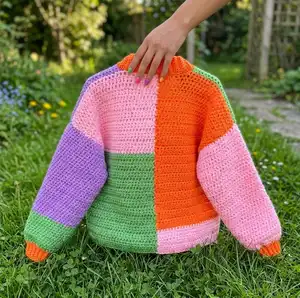
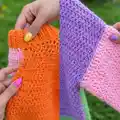
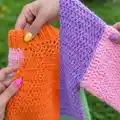
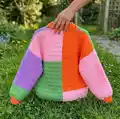
Make a vibrant, cozy colorblock oversized cardigan with this beginner-friendly crochet pattern. Youll work simple stitches to create front panels, sleeves, and a back panel, then sew everything together for a custom oversized fit. This pattern gives you total freedom to choose colors and layout so you can create a unique handmade piece youll love wearing. Detailed step-by-step instructions and photos guide you through every stage.
Progress Tracker
0% Complete
— Overview :
Info :
This colorblock oversized dream cardigan is originally made of 5-ply milk cotton (80% cotton, 20% acrylic), worsted weight yarn. This cardigan is created by working on the front panels first followed by the sleeves then the back panel. Afterwards, the panels and sleeves are attached together followed by the addition of ribbings and buttons. The pattern for this cardigan is composed of simple stitches and provides you liberty in customizing the color layout. You can even add appliques afterwards if you want!
— Materials :
Round Step 1 :
Hook size 5.0mm
Round Step 2 :
Worsted weight yarn of your colors of choice (You can use as many colors as you want!)
Round Step 3 :
Yarn amounts per size: XS - 400g, S - 600g, M - 800g, L - 1,000g, XL - 1,200g, XXL - 1,400g
Round Step 4 :
If you want to achieve the same color block pattern that I did, I used an equal amount of yarns of different colors. e.g. For size S, I used 150g of each yarn color (total of 4 colors)
Round Step 5 :
Stitch markers
Round Step 6 :
Tapestry needle
Round Step 8 :
Measuring tape
— Measurements (inches) :
Info :
Ribbings width: 2 inches for all sizes. Front panel width XS 10, S 11, M 12, L 13, XL 14, XXL 15. Front panel length XS 18, S 20, M 22, L 24, XL 26, XXL 28. Back panel width XS 22, S 24, M 26, L 28, XL 30, XXL 32. Sleeve length and width to measure.
— Terminologies (US) :
Info :
sl st - slip stitch. ch - chain. st - stitch. sc - single crochet. hdc - half double crochet. dc - double crochet. BLOsc - back loop only sc. BLOhdc - back loop only hdc. Note: ch 2 at the beginning of each row does NOT count as a stitch.
— Gauge :
Info :
5" x 5" square = 17 hdc x 12 rows. Please refer to this gauge if you are using a different weight of yarn or hook size so that you will be able to easily adjust your number of stitches.
— Sizing Guide :
Info :
The number of stitches per size follows: XS, (S, M, L, XL, XXL). e.g. Chain 10 (15, 20, 25, 30, 35). It means: if you are a size XS, chain 10. if you are a size S, chain 15. if you are a size M, chain 20. if you are a size L, chain 25. if you are a size XL, chain 30. if you are a size XXL, chain 35. If only one number is indicated, it is applicable for all sizes.
— Reading Guide :
Info :
All texts including photos are to be read from left to right. Correct side means the side that should be facing outside. Most panels are created facing the correct side.
— Customizing the Pattern :
Info :
Because it is composed of basic stitches, the pattern is very easy to customize. Increase/decrease your number of chain stitches to achieve your desired width. When you customize the width, make sure that the total width of your front panels plus the width of your ribbing is equal to the total width of the back panel. Width of back panel = width of right + left front panels + width of ribbing. In this pattern, all ribbings have a width of 2 inches. Add/subtract rows to achieve your desired length. When you customize the length, make sure that all front and back panels have the same number of rows.
— Changing Colors :
Info :
You can change colors and create as many color blocks as you want!
Round Step 1 :
To change colors while doing the front and back panels: After you secure the end of your row and fasten off the yarn, choose the next yarn color that you want to use and create a slip knot.
Round Step 2 :
Insert the hook onto the stitch where you ended. Create a sl st. Ch2. Hdc on the same st. You can now start working on your row with your new yarn color.
Round Step 3 :
To change colors while doing the sleeves: After you secure the end of your row and fasten off the yarn, choose the next yarn color that you want to use and create a slip knot. Insert the hook onto the stitch where you ended. Create a sl st, ch2, dc on the next st. You can now start working on your row with your new yarn color.
Info :
Note: When you change color while doing the sleeves, always do the dc on the next st EXCEPT when you are working on the 1st row of the sleeve (row right after the cuff).
— Crocheting the Colorblock Oversized Cardigan :
Info :
NOTE: Make sure that you use the same tension all throughout the project so that all panels will have the same sizes/dimensions.
— Front Panels :
Info :
For the front panels, you will start working from the bottom all the way up until you start doing the alternating decrease - non-decrease rows to create the V-shape on the upper half of the cardigan.
— Front Panel 1 :
Round Step 1 :
Using your color of choice: Step 1. Chain 35 (39, 43, 47, 51, 55).
Round Step 2 :
Step 2. Skip 2ch then hdc on the 3rd ch from the hook.
Round Step 3 :
Step 3. Hdc on each ch until you reach the end of the row. You should have a total of 33 (37, 41, 45, 49, 53) hdcs.
Round Step 4 :
Step 4. Ch 2. Flip your work then hdc on the same st. Hdc on each of the next sts until you reach the end of the row.
Round Step 5 :
Step 5. Repeat Step 4 until you make a total of 24 (26, 28, 30, 32, 34) rows.
Info :
You will now start working on the upper part of the cardigan. To do the V-shape you will start making the alternating decrease – non-decrease rows.
Round Step 6 :
Step 6. Ch 2. Flip your work then hdc on the same st. Hdc on each of the next sts until you reach the last 2 sts. For the last 2 sts, make an hdc2tog (decrease row).
Info :
To make an hdc2tog, yarn over, insert hook into the stitch, yarn over and pull up a loop (3 loops on the hook), yarn over, insert hook into the next stitch, yarn over and pull up a loop (5 loops on the hook), yarn over and pull through all 5 loops on the hook.
Round Step 7 :
Step 7. Ch 2. Flip your work then hdc on the same st. Hdc on each of the next sts until you reach the end of the row (non-decrease row).
Round Step 8 :
Step 8. Ch 2. Flip your work then hdc on the same st. Hdc on each of the next sts until you reach the last 2 sts. For the last 2 sts, make an hdc2tog (decrease row).
Round Step 9 :
Step 9. Repeat steps 7-8 until you make a total of 18 (20, 22, 24, 26, 28) rows starting from the row where you placed the stitch marker. Include the row with the stitch marker when counting.
Round Step 10 :
Step 10. After the last hdc on the last row, ch 1 and fasten off. If you ended the row on the outer side of the panel (the one with a straight edge), leave a tail that is 3x longer than the length of the last row of the front panel. If you ended the row on the inner side of the panel (the one with the V-Shape), leave a tail long enough for weaving.
— Front Panel 2 :
Round Step 1 :
Using your color of choice: For the lower half of the front panel 2, repeat steps 1-5 of the front panel 1.
Info :
You will now start working on the upper part of the cardigan. To do the V-shape you will start making the alternating decrease – non-decrease rows.
Round Step 2 :
Step 6. Ch 1. Flip your work then make an hdc2tog on the first 2 sts. Hdc on each of the next sts until you reach the end of the row (decrease row).
Round Step 3 :
Put a stitch marker on your hdc2tog to remind you which side you are going to do the hdc2tog. The stitch marker will also help you count the rows for the upper part of the cardigan.
Round Step 4 :
Step 7. Ch 2. Flip your work then hdc on the same st. Hdc on each of the next sts until you reach the end of the row (non-decrease row).
Round Step 5 :
Step 8. Ch 1. Flip your work then make an hdc2tog on the first 2 sts. Hdc on each of the next sts until you reach the end of the row (decrease row).
Round Step 6 :
Step 9. Repeat steps 7-8 until you make a total of 18 (20, 22, 24, 26, 28) rows starting from the row where you placed the stitch marker. Include the row with the stitch marker when counting.
Round Step 7 :
Step 10. After the last hdc on the last row, ch 1 and fasten off. If you ended the row on the outer side of the panel (the one with a straight edge), leave a tail that is 3x longer than the length of the last row of the front panel. If you ended the row on the inner side of the panel (the one with the V-Shape), leave a tail long enough for weaving.
Info :
NOTE: If you want to change the color of your front panels along the way, follow the instructions under Customizing the Pattern part (page 4).
— Sleeves :
Info :
For the sleeves, you will start working from the cuff ribbing then to the sleeve which is worked in rounds.
— Cuff Ribbing :
Round Step 1 :
Using your color of choice: Step 1. Chain 10.
Round Step 2 :
Step 2. Hdc on the 3rd chain from the hook. Hdc until you reach the end of the row. You should now have a total of 8 hdcs.
Round Step 3 :
Step 3. Ch2. Flip your work. Do a BLOhdc until you reach the end of the row. Make sure you have a total of 8 hdcs. (To do a BLOhdc, make sure you insert your hdc on the back loop only of each st.)
Round Step 4 :
Step 4. Repeat step 3 until you make a total of 12 (13,14,15,16,17) rows or until the length of the cuff ribbing when stretched covers your entire wrist. Make sure you are comfortable. Some materials stretch less so you might want to add a few more rows.
Round Step 5 :
Step 5. Now you will attach both ends of the cuff ribbing by doing a sl st on the inner loops only.
Round Step 6 :
Step 6. Once you reach the end of the row, make 2sc on the 1st hdc post then 1 sc on the next hdc post.
Round Step 7 :
Step 7. Place alternating 2sc then 1 sc on each of the next hdc posts until you reach the end. When you reach the end of the row, sl st on the st before the 1st sc that you created.
Round Step 8 :
Step 8. You have now created the cuff ribbing. Repeat Step 1 from the cuff ribbing until Step 10 of the sleeves to create the 2nd sleeve.
— Sleeves (continued) :
Round Step 1 :
If you are using the same yarn that you used for the cuff: Ch2 then dc on the same st (then go to Step 2). If you are using a color different from the cuff: Insert the hook into any st in the row. Sl st. Ch2 then dc on the same st.
Round Step 2 :
Step 2. 2dc on the next st. Do the alternating 1dc and 2dc on each of the next sts until you reach the end of the row. Sl st on the 1st dc of the row.
Round Step 3 :
Step 3. Ch2. Dc on the next st then 2 dc on the next st.
Round Step 4 :
Step 4. Do the alternating 1dc and 2dc on each of the next sts until you reach the end of the row. If you ended your row with 1dc, add 2dc on the same stitch where you placed the ch2 at the start of the row. Sl st on the 1st dc of the row. If you ended your row with 2dc, add 1dc on the same stitch where you placed the ch2 at the start of the row. Sl st on the 1st dc of the row.
Round Step 5 :
Step 5. Ch2. DC on the same st. 1dc on each of the next 2 sts. Then 2dcs on the next st.
Round Step 6 :
Step 6. Place 1dc into each of the next 3 sts then 2dcs on the next st. Repeat this step until you reach the end of the row. Sl st on the 1st dc of the row.
Round Step 7 :
Step 7. Ch2. DC on the next st then 1 dc on each of the next sts until you reach the end of your row. Add another dc on the same stitch where you placed the ch2 at the start of the row. Sl st on the 1st dc of the row.
Round Step 8 :
Step 8. Ch2. Dc on the same st then 1 dc on each of the next sts until you reach the end of the row. Sl st on the 1st dc of the row.
Round Step 9 :
Step 9. Repeat steps 7-8 until you reach your desired sleeve length.
Round Step 10 :
Step 10. After the last dc on the last row, ch 1, cut the yarn leaving a tail with a length that is equal to 4x the length of your front panels. You will use this tail later when you attach the different panels together.
Info :
NOTE: If you want to change the color of your sleeves along the way, follow the instructions under Customizing the Pattern part (page 5).
— Back Panel :
Info :
For the back panel, you can design it in two ways: 1. Horizontal layers of different colors – simple and perfect for beginners or for those who want minimal sewing. 2. Colorblock pattern – requires sewing using the mattress stitch or any other stitch you are comfortable with.
— Design 1: Horizontal Layers :
Round Step 1 :
NOTE: Identify how you want to layout your colors first, as well as how you want to match it with the front panels and sleeves. To make sure that the rows of the back panel will match with the rows of the front panel, start working from the bottom, all the way up.
Round Step 2 :
Using your color of choice: Step 1. Chain 76 (84, 92, 100, 108, 116). Hdc on the 3rd chain from the hook. Hdc on each of the next sts until you reach the end of the row.
Round Step 3 :
Step 2. Ch 2. Flip your work then hdc on the same st. Hdc on each of the next sts until you reach the end of the row.
Round Step 4 :
Step 3. Repeat Step 2 until you reach your desired length for that color. Cut the yarn and fasten off.
Round Step 5 :
Step 4. To start with your new color, create a slip knot with your new yarn color, sl st on the st where you ended.
Round Step 6 :
Step 5. Ch2. Flip your work then hdc on the same st. Hdc on each of the next sts until you reach the end of the row.
Round Step 7 :
Step 6. Repeat Step 5 until you reach your desired length for that color. Ch1, cut the yarn and fasten off. Do as many color changes as you want by repeating steps 4-6. Make sure that the total number of rows of the back panel match the total number of rows of your front panel.
— Design 2: Colorblock Pattern :
Round Step 1 :
For this design, you are basically doing the same steps for Design 1 except you create 2 separate back panels and sew them together.
Round Step 2 :
Using your color of choice: Step 1. Chain 39 (43, 47, 51, 55, 59). Hdc on the 3rd chain from the hook. Hdc on each of the next sts until you reach the end of the row.
Round Step 3 :
Step 2. Ch 2. Flip your work then hdc on the same st. Hdc on each of the next sts until you reach the end of the row.
Round Step 4 :
Step 3. Repeat Step 2 until you reach your desired length for that color. Cut the yarn and fasten off.
Round Step 5 :
Step 4. To start with your new color, create a slip knot with your new yarn color, sl st on the st where you ended.
Round Step 6 :
Step 5. Ch2. Flip your work then hdc on the same st. Hdc on each of the next sts until you reach the end of the row. Step 6. Repeat Step 5 until you reach your desired length for that color. Ch1, cut the yarn and fasten off. You have now created the other half of your back panel. To create the remaining half, repeat steps 1-6 using your other color choices. Once you have created the two halves of your back panel, you have to connect them using the mattress stitch.
— Doing the Mattress Stitch :
Round Step 1 :
The mattress stitch is like tying your shoelaces, you work from side to side, inserting the laces from the bottom going up. To do the mattress stitch, align the rows that you want to connect. Select the yarn color that you want to use. Please note that when doing the mattress stitch, the stitches will be invisible so it is okay to use a different yarn color. Work facing the correct side of the panels (correct side means the side that should be facing outside).
Round Step 2 :
Step 1. Cut a yarn with a length equal to 3x the length of your back panel.
Round Step 3 :
Step 2. Using your tapestry needle, insert the yarn through the first stitch on the right panel from the bottom going up. Leave enough end (1-2 inches) for weaving.
Round Step 4 :
Step 3. Then insert the yarn through the first stitch on the left panel from the bottom going up.
Round Step 5 :
Step 4. To secure your first stitch, insert the yarn once more through the first stitch on the right panel from the bottom going up. Then to the first stitch on the left from the bottom going up. You can make a single knot to make sure that the ends are secured.
Round Step 6 :
From this point forward, you will be working on the outermost post of each row (for rows where the outermost stitch is the ch2, work on the ch2). When inserting the needle, remember to always get at least 2 loops from the outermost post to make sure that the connection will be sturdy and secure.
Round Step 7 :
Step 5. Insert the needle to the outermost post of the opposite panel, from the bottom going up, do the same to the other panel. Do this until you reach the post on the last row. Make sure that the rows match while you are stitching them together.
Round Step 8 :
Step 6. To end the mattress stitch, you will basically do the same steps as when you started. Insert the yarn through the first stitch on the right from the bottom going up. Insert the yarn through the first stitch on the left from the bottom going up. Repeat again from * to secure your last stitch. Make a single knot then fasten off.
— Attaching the Panels and Sleeves :
Round Step 1 :
Attaching the front and back panels together: You will start by attaching the top portion of the front panel to the top portion of the back panel through the mattress stitch. Make sure that the rows match. Work facing the correct side of the panels (correct side means the side that should be facing outside).
Round Step 2 :
Step 1. Start sewing from the outer edge going to the middle part of the cardigan by doing steps 1-3 under the Doing the Mattress Stitch (page 16).
Round Step 3 :
Step 2. For the next stitches, continue stitching from side to side, inserting from the bottom going up, until you reach the last stitch in your front panel.
Round Step 4 :
Step 3. Make a single knot then fasten off. Do the same for the other side. You have now created the shoulder part of your cardigan!
Round Step 5 :
Attaching the sleeve to the body: For this part, you will use mattress stitch to attach the sleeves to the front and back panel then down to attach the sides of the cardigan. Work facing the correct side (correct side means the side that should be facing outside). Note: if you are more comfortable using sc or any other stitch when connecting panels together, you may also use those.
Round Step 6 :
Step 1. Fold your sleeves in such a way that the seam will be positioned at the bottom (underarm area).
Round Step 7 :
Step 2. Using your stitch markers, mark the topmost portion of the sleeves, then mark the rows in your front and back panel where you want to attach the sleeves. Make sure that the position in the front is similar to the position in the back panel. e.g. If you put the stitch marker on the 20th row of the front panel, make sure to also put the stitch marker on the 20th row of the back panel.
Round Step 8 :
Step 3. Attach the sleeves to the front panel first by doing the mattress stitch. You will work from the underarm area all the way up to the shoulders. Since you left a long tail for the sleeves, you will start the mattress stitch by inserting the needle to the outermost post of your marked row in the front panel. Continue doing the mattress stitch all the way up. Take note of the topmost stitch of the sleeve where you placed the stitch marker. This stitch should be connected to the topmost portion of the cardigan.
Round Step 9 :
Tip: When attaching the sleeve, 1 post in the panel is not necessarily equal to 1 stitch in the sleeve. Sometimes you have to make 2 mattress stitches in a single post in the front panel to match the stitches in the sleeves.
This Colorblock Oversized Cardigan pattern is your ticket to a bright, wearable statement piece that youll be proud to make by hand. Mix and match colors, adjust the width and length, and customize every panel for a truly unique garment. Whether you make a bold multicolor version or a subtle two-tone, this cardigan becomes a cozy favorite in your wardrobe. 🧶✨😊