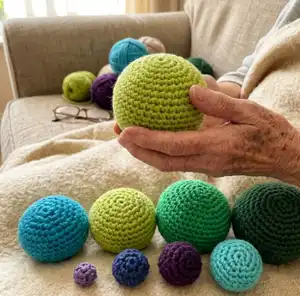
Make perfect crochet balls in any size with this flexible amigurumi pattern. You can follow the full eight-row example or use the simple maths to scale up or down to get the circumference you want. It is written in UK crochet terms and shows how to measure your yarn and stitches so you can make accurate, well-shaped spheres. A great way to use leftover yarn or create toys, baubles, and decorative spheres.
Progress Tracker
0% Complete
— Pattern Overview :
Info :
Work this in amigurumi style, in spirals, marking your row start (or end, as you please) so you don't lose track. No stepping up. This is written in UK style - US, see the abbreviations to translate.
Info :
See the start of the method for the mathematical logic behind this pattern, or skip it if you are not interested. I've given the full instructions for a ball with eight rows in the top circle section, and told you how to extract the rows you need for smaller balls as well as how to add more rows for larger ones. To make a ball the size you want, or to work out how big a ball you can make from the yarn you have, see the end sections. I've also included a short list of ideas for using balls.
— Materials :
Info :
Firm yarn - I've used PaintBox DK cotton for the main set of samples. Crochet hook to match the yarn - one size less than the yarn usually asks for is a good idea, to get a firmer fabric, so I used a 3.5mm hook instead of a 4mm for the DK cotton. Large-eye needle (or smaller hook) to finish the ends (pull through inside).
— Size :
Info :
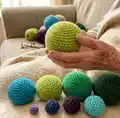
Just about any size you like. The balls in the main picture have circumferences of about 2.5, 5, 7.5, 10, 12.5, 15, 17.5 and 20 cm (1, 2, 3, 4, 5, 6, 7 and 8 inches). See Choosing the Size of your Ball for how to work out how to make the size you want - or to work out what size you are going to get from the number of rows and the yarn you have.
— Tension :
Info :
Absolutely depends on your yarn, but ideally firm. The basis of this pattern is that a dc (US - sc) crochet stitch is more-or-less the same height as its width. See the section on Choosing the Size of your Ball for more about tension and size.
— Abbreviations :
Infos :
dc - double crochet, (what the US calls sc). dec - decrease, work two stitches together, dc two together (US, sc two together). Either pull one loop through each of the next two stitches so you have three loops on the hook and then finish them off together, or do an invisible decrease.
— Method :
Info :
Read this next part if you are interested in how this pattern works. If you don't care and just want to make a ball, go on to 'Top Section'.
Info :
You do not need to understand this bit of maths to make the balls.
Info :
The basis of this pattern is that a crochet dc stitch (US, sc, but I'm saying dc here) is more-or-less square, that is it is the same width as it is high - so you could make a square with five stitches and five rows, or any number of stitches and the same number of rows.
Info :
To make a ball, you need a circle (more or less) at the top and bottom, which will be pulled into a curved shape by the flat repeated rows around the middle - I know, it sounds wrong, but the way crochet stitches move against each other on the rows, it does work. To make the circle section, you can use the standard six-stitches in a magic ring and increase six evenly all around each row until you have the circumference you need for your ball (the circumference is the measurement all the way around the widest part of the ball - for example, the distance around the Equator is the circumference of the Earth). If you increase in the same place every time, you get a hexagon - it will still make a sphere, but it's not quite as neat as if you offset the increases, so for the rows with even numbers of stitches between increases I offset the place by half - you'll see how that goes when you read through the pattern. You then get more-or-less a circle.
Info :
In any case, the number of stitches is 6 times the number of rows you have done, since you start with six and increase six each time.
Info :
So, you have a circle with a number of stitches in the last row, which is its circumference. Call that X. You will need there to be the same total number of rows around the ball, so that it has the same distance around it from every direction. Since half of the rows will be on one side, and half on the other, you need half as many rows in total as the number of stitches in the last row of the circle section.
Info :
There will be another circle section at the top, decreasing in the same way as the increases. So, you have a number of rows you've done to get to the end of the circle section, and there will be the same number at the top. Call that Y.
Info :
Here's the maths. There are X stitches in the last row. It took Y rows to get here. Z is the number of rows we will need between the circle sections to make the ball the right height. X = 6Y (because of the increases). 2Y + Z = half of X = 3Y. Z = 3Y - 2Y = Y. So however many rows we have in our base circle section, we need that many rows without shaping, just one stitch in each stitch, to make the finished ball the same height as it is wide!
— Working a Ball :
Info :
Top Section for an eight-row circle ball: Note - repeat just the section in the brackets just before the word repeat! The bracket at the end is the number of stitches you should now have in the row - it is always a multiple of six.
Round 1 :
6 dc into a magic ring. (6)
Round 2 :
2dc into each dc (12)
Round 3 :
(dc, 2dc in next dc) repeat 6 times (18)
Round 4 :
1 dc, 2dc in next dc, (2 dc, 2dc in next dc) repeat 5 times, 1 dc (24)
Round 5 :
(3 dc, 2dc in next dc) repeat 6 times (30)
Round 6 :
2 dc, 2dc in next dc, (4 dc, 2dc in next dc) repeat 5 times, 2 dc (36)
Round 7 :
(5 dc, 2dc in next dc) repeat 6 times (42)
Round 8 :
3 dc, 2dc in next dc, (6 dc, 2dc in next dc) repeat 5 times, 3 dc (48)
— Middle section (any ball) :
Round Info :
Middle Row: 1dc in each dc to end - repeat until you have as many 'middle rows' as you have rows in your top (circle) section.
— Bottom Section for an eight-row circle ball :
Info :
Note: These row numbers count DOWN to the top of the ball, so for an eight row circle ball the next row is row 8. Read the notes, below, on stuffing before the hole in your ball gets too small.
Round 8 :
3 dc, dec, (6 dc, dec) repeat 5 times, 3 dc (42)
Round 7 :
(5 dc, dec) repeat 6 times (36)
Round 6 :
2 dc, dec, (4 dc, dec) repeat 5 times, 2 dc (30)
Round 5 :
(3 dc, dec) repeat 6 times (24)
Round 4 :
1 dc, dec, (2 dc, dec) repeat 5 times, 1 dc (18)
Round 3 :
(dc, dec) repeat 6 times (12)
Round 1 :
Cut the yarn, leaving a long tail. Put the tail in a sewing needle, and thread through the front loop of each of the remaining 6 stitches going around the ring in the same direction you were working. Pull tight and finish the end, hiding it inside the ball.
— Stuffing :
Info :
Do not stuff the ball too firmly, it will distort the shape. Try to stuff evenly, if possible with small balls just use one piece of stuffing pushed in at perhaps the 18 stitch row (balls smaller than this may not need stuffing at all). If you need a lot of stuffing, try putting in a fairly large amount to start with and then spreading it out so that you can put the rest into the middle of the stuffing you've already put in - this tends to give a smoother, more even result. When you've finished off the ball, roll it in your hands for a while (or on a flat surface if it's too big for that) until it's as round as you can make it.
— The other 7 smallest sizes :
Info :
Yes, I said the first eight sizes were given in full. They are. Just take the first however many rows you want from the eight‑row ball, the middle section, and the last same-number of rows, counting from the end. So for the tiniest ball with the yarn you have, just the first row, one middle row, and the last row. For the next size, the first two rows, two middle rows, and the last two rows. And so on for the first seven sizes.
— Larger Sizes :
Info :
OK, for larger sizes I think you can probably see how it goes. Every row of the top circle section you increase (2dc in next dc) six stitches, evenly spread around the ball. The number of stitches between the increases gets bigger by one stitch on each row.
Info :
If this is an odd number, start the row with that number of stitches, increase, then repeat that until the end of the row. For example, rows 3, 5 and 7 on the method above. If it is an even number, then to put the increase in the middle of the space rather than in the same place as the increase on the previous row, you start with HALF that number of stitches, increase, then (the full number, increase) five times, then that half number again and you should be at the end of the row. For example, rows 4, 6 and 8 on the method above.
Info :
The middle is always the same - unshaped rows of the same number as the number of rows in your top circle.
Info :
Note: If you are getting very big, and your stitches are not quite the same height as width, you may need to change this a little - measure your circumference, do half the number of middle rows you should need, and check that the dome you have made is half that measurement from one edge to the other measured over the top of that dome.
— Choosing the size of your ball :
Info :
To work out how to make a ball the size you want, you need to know the size of the stitch you get from your yarn with the hook you are using. I do this by making a little sample of crochet about 15 stitches wide and ten rows high (because I feel the first few rows may be distorted by the chain at the beginning). Measure the width of six of the stitches in the middle (ish) of the last row. This is your Unit Measurement. One stitch is a sixth of this, but the measurement you just took is the one you need because all the ball circumferences are a multiple of six stitches.
Info :
Note: if you want to work out how much yarn you need for your ball, or how large a ball you can make with the yarn you have, you will also want to weigh this sample or measure the amount of yarn it took (when you undo it to reuse the yarn). It has 150 stitches.
Info :
I get a Unit Measurement very close to 2.5 (two and a half) cm, near enough one inch, with PaintBox DK cotton and a 3.5mm hook. So if I wanted a ball with a 6 inch (15cm) circumference, I would need a six-row circle ball with this yarn.
Info :
However, if I wanted a ball with a 5.5 (five and a half) inch, 14cm, circumference, I couldn't do it with that yarn and hook - I would have to try perhaps a smaller hook to get 2.33 (two and a third) cm, about nine tenths of an inch, for a six row, or a different yarn, perhaps a thicker one, to get 2.8 cm, one-and a tenth inches and do a five-row ball.
Info :
The balls here are all six-row and are made with Catania (a sport weight) and a 2.5mm hook, the PaintBox DK and PaintBox cotton Aran with a 4mm hook. The Unit Measurement for Catania is about 2cm, 8/10 of an inch, and for the Aran is about 3cm, one and a fifth (1.2) inches, so the three balls have circumferences of roughly 12cm, 15cm, 18cm (4.8ins, 6ins, 7.2ins) in that order.
— How much Yarn / How big a ball from my Yarn? :
Info :
You may want to know how much yarn you need for a ball, or how big a ball you can make from whatever amount of yarn you have left from a previous project. To do this, you need to know either the weight or the length of yarn needed for (say) 100 stitches in your yarn. So make a trial piece 10 stitches by 10 rows (or similar), and either weigh it or undo it and measure how much yarn it took. If you've done the 15 x 10 piece above to try out the size of the stitches, take two-thirds of your result for that (because that was 150 stitches).
Info :
Now, each ball has 6 stitches in the first row, 2x6 in the second row, 3x6 in the third etc. up to N x 6, then has N rows of N x 6 stitches where N is the number of rows which defines the size of the ball, so that is N x N x 6 stitches. Plus of course the same size circle section at the base.
Info :
So we need to add up all the stitches in the top section, multiply by two (so we have the bottom section as well) and add the number in the middle. I've done this for you on a chart for the first 12 sizes - if you are doing a bigger ball, you'll need to do the maths to add on to this. I do it by adding six to the number in the row, then adding that to the last circle size, then doing the rest of the sum. Don't forget to multiply the circle stitches by two as well as adding in the middle section.
Info :
Number of stitches in a ball: (table of first 12 sizes) Row counts shown as: 1 row: circle stitches 6, middle 6, total 18. 2 rows: 18, 24, 60. 3 rows: 36, 54, 126. 4 rows: 60, 96, 216. 5 rows: 90, 150, 330. 6 rows: 126, 216, 468. 7 rows: 168, 294, 630. 8 rows: 216, 384, 816. 9 rows: 270, 486, 1026. 10 rows: 330, 600, 1260. 11 rows: 396, 726, 1518. 12 rows: 486, 864, 1836.
— Ideas for using balls :
Info :
Of course the most obvious thing is for soft things for young folk to throw around. I made quite a few larger ones of these for babies and toddlers (DO make sure it is stitched up well so they can't get at the stuffing!) before I worked out this pattern, so some of mine are a bit oval - taller than they are wide or wider than they are tall, but that didn't really matter to the kids, it seemed.
Info :
For winter holidays, you could make baubles - use yarns that shade, or change colours every row, or do something elaborate with colour. The middle section where you have no increases or decreases should be a good place to make a pattern. You could also use two or three balls of different sizes to make a snowman (snowperson?) with a few felt or crochet add-ons.
Info :
Small balls in pretty or even sparkly yarns can be used as beads - you could make a graduated necklace. You could even cover some wood or plastic beads as a base, rather than stuffing the balls, if your yarn is stretchy enough to fit over the bead and you can finish the last row or two with it in place.
Info :
Balls make decent heads for dolls or animals, and you can make half or so of a ball in the next size up as hair - add some shaping to the last row or two. A ball with a few more rows in the middle to make it an oval can make a decent body for a toy, too.
Info :
I'm sure you'll have more ideas!
This ball pattern gives you freedom to make spheres in nearly any size with simple maths and easy crochet techniques. 🎁 Use leftovers or make a set in matching colours for toys, necklaces, or seasonal baubles. I hope these instructions inspire you to experiment and create delightful handmade spheres. 🧶