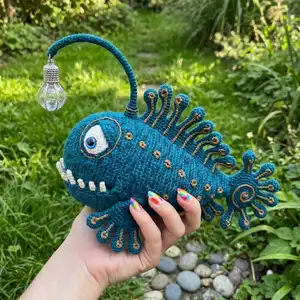
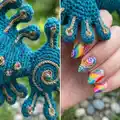
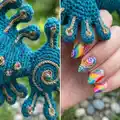
Make a whimsical anglerfish named SAM with this detailed intermediate amigurumi pattern. You will build a textured, wired fish with fins, spines, teeth, and a light-up lure using step-by-step instructions. The pattern includes full stitch counts, reinforcement guidance, and finishing tips so your SAM keeps its shape. Perfect for crafters who enjoy assembly and unique, decorative toys.
Progress Tracker
0% Complete
— Fins :
Side fin :
Make two with solid yarn and 1.5 mm crochet hook following the instructions. Start with finger-rays using solid yarn and 1.5 mm crochet hook. The following instructions are given for one fin!
Round 1 :
Make a MR, 6 sc into the ring (6)
Round 2 :
2 sc in each st around (12)
Round 3 :
(3 sc, 2 sc in next st) * 3 (15)
Round 4-5 :
sc in each st around (15)
Round 6 :
(3 sc, 2 sc tog) * 3 (12)
Round 7 :
(sc, 2 sc tog) * 4 (8)
Round 8-10 :
sc in each st around (8)
Infos :
After having made one ray, cut off the yarn, but do not cut the yarn after having made the second ray. Continue working from the marker of the second ray.
Round 11 :
2 sc in next st, 2 sc, (2 sc in next st) * 2, 2 sc, 2 sc in next st (12). Fasten off, weave in the end.
Round Join :
Join the rays together according to the following instructions. This sign means increase of the previous rnd, so the diagram shows how to place fingers "B" and at what places to join the rays to each other (you have to match the increases with increases). When joining rays together you DO NOT have to make increases or decreases! Attention! In order to avoid holes between the rays when joining them together you have to do the following: draw up one more loop through the same place where you have just made a sc as you are going to make another sc but do not crochet it. As a result, you have two sts on the hook. Then draw up another loop through the st in the previous rnd of the other ray (the one you are going to join the first ray to). As a result, you have 3 sts on the hook. Now you have to make a sc through the all 3 sts. It looks like you have made increase and decrease at the same time and in the end you have made only one sc.
Round Join 2 :
Join the rays together according to the diagram shown above: 4 sc around finger "A" (make the 4th sc as described above to avoid holes - do not forget to do this when joining all the other rays!), 6 sc around finger "B", 6 sc around finger "B", 8 sc around finger "A"; turn work and continue in the opposite direction: 6 sc around finger "B", 6 sc around finger "B", 4 sc around finger "A" (40)
Round 2 :
2 sc tog, 16 sc, (2 sc tog) * 2, 16 sc, 2 sc tog (36) + shift st
Round 3 :
(16 sc, 2 sc tog) * 2 (34)
Round 4 :
(15 sc, 2 sc tog) * 2 (32) + shift st
Round 5 :
(14 sc, 2 sc tog) * 2 (30)
Round 6 :
(13 sc, 2 sc tog) * 2 (28) + shift st
Round 7 :
(12 sc, 2 sc tog) * 2 (26)
Round 8 :
(11 sc, 2 sc tog) * 2 (24) + shift st
Round 9 :
(10 sc, 2 sc tog) * 2 (22). Change the yarn into the multicolor yarn.
Round 10 :
(9 sc, 2 sc tog) * 2 (20) + shift st
Round 11-13 :
sc in each st around (20) + shift st
Round 14 :
(9 sc, 2 sc in next st) * 2 (22)
Round 15 :
(10 sc, 2 sc in next st) * 2 (24). Fasten off and weave in the end. Stuff the finger-rays with polyester (do not stuff too tightly!). Do not stuff the fin itself.
Infos :
Reinforce the fin. You will need at least 120 cm of wire for one fin (it is much better to cut off excess wire than to add more wire). Insert the even parts of the wire into each finger so to make the ends coming out of the fin even. One end of the wire will make the frame of the fishing line and the other end will form the spine of the fish.
Lower fin :
Make one with solid yarn and 1.5 mm crochet hook following the instructions. Instructions how to make finger-rays:
Round 1 :
Make a MR, 6 sc into the ring (6)
Round 2 :
2 sc in each st around (12)
Round 3 :
(3 sc, 2 sc in next st) * 3 (15)
Round 4-5 :
sc in each st around (15)
Round 6 :
(3 sc, 2 sc tog) * 3 (12)
Round 7 :
(sc, 2 sc tog) * 4 (8)
Round 8-9 :
sc in each st around (8)
Infos :
After having made one ray, cut off the yarn and weave in the end, but do not cut the yarn after having made the second ray. Continue working from the marker of the second ray.
Round 10 :
2 sc in next at, 2 sc, (2 sc in next st) * 2, 2 sc, 2 sc in next st (12). Fasten off, weave in the end.
Join :
Join the rays together according to the diagram shown above: 4 sc around finger "A" (make the 4th sc as described above to avoid holes - do not forget to do this when joining all the other rays!), 6 sc around finger "B", 8 sc around finger "A", turn work and continue in the opposite direction: 6 sc around finger "B", 4 sc around finger "A" (28).
Round 2 :
(2 sc in next st, 13 sc) * 2 (30) + shift st
Round 3 :
(2 sc in next st, 14 sc) * 2 (32)
Round 4 :
(2 sc in next st, 15 sc) * 2 (34). Fasten off and weave in the end. Do not insert the wire at this step. Stuff the finger-rays with polyester (do not stuff too tightly!). Do not stuff the fin itself.
Dorsal fin :
Make one with solid yarn and 1.5 mm crochet hook following the instructions. Attention! In order not to mix the fingers I recommend grouping them and labeling them with name labels (see Appendix).
Round 1 :
Make a MR, 6 sc into the ring (6)
Round 2 :
2 sc in each st around (12)
Round 3 :
(3 sc, 2 sc in next st) * 3 (15)
Round 4-5 :
sc in each st around (15)
Round 6 :
(3 sc, 2 sc tog) * 3 (12)
Round 7 :
(sc, 2 sc tog) * 4 (8)
Round 8-12 :
sc in each st around (8) for A rays; sc in each st around (8) for other ray-types as specified in the chart. Do not cut the yarn; continue working from the marker of this ray for some ray types.
Round Extra :
Follow the charted instructions for B, C, D and E ray types for additional rows and finishing sequences; complete those rays and fasten off where indicated, weaving in the ends.
Join :
Join the rays together according to the diagram shown above: 4 sc around finger "A" (make the 4th sc as described above to avoid holes), 6 sc around finger "B", 6 sc around finger "C", 5 sc, (2 sc in next st) * 2, 5 sc around finger "D"; turn work and continue in the opposite direction: 6 sc around finger "C", 6 sc around finger "C", 6 sc around finger "B", 4 sc around finger "A" (58).
Join Step 2 :
Join the rays together according to the diagram shown below: 2 sc in next st, 28 sc around the item you have just made, 5 sc, (2 sc in next st) * 2, 5 sc around finger "D", turn work and continue in the opposite direction: 29 sc around the item you have just made (73) + shift st.
Join Step 3 :
Join the rays together according to the diagram shown below: 2 sc in next st, 36 sc around the item you have just made, 5 sc, (2 sc in next st) * 2, 5 sc around finger "D", turn work and continue in the opposite direction: 36 sc around the item you have just made (88).
Join Step 4 :
Join the rays together according to the diagram shown below: 2 sc in next st, 43 sc around the item you have just made, 3 sc, 2 sc in next st, 4 sc around finger "E", turn work and continue in the opposite direction: 44 sc around the item you have just made (98).
Rounds 5-7 :
5) (2 sc in next st, 48 sc) * 2 (100) + shift st. 6) (2 sc in next st, 49 sc) * 2 (102) + shift st. 7) (2 sc in next st, 50 sc) * 2 (104). Fasten off and weave in the end. Do not insert the wire at this step. The item you have just made may twist; when you insert the wire it will stop twisting. Stuff the finger-rays with polyester (do not stuff too tightly!). Do not stuff the fin itself.
Tail :
Make one with solid yarn and 1.5 mm crochet hook following the instructions. Instructions how to make finger-rays:
Round 1 :
Make a MR, 6 sc into the ring (6)
Round 2 :
2 sc in each st around (12)
Round 3 :
(3 sc, 2 sc in next st) * 3 (15)
Round 4-5 :
sc in each st around (15)
Round 6 :
(3 sc, 2 sc tog) * 3 (12)
Round 7 :
(sc, 2 sc tog) * 4 (8)
Round 8-11 :
sc in each st around (8)
Infos :
Do not cut the yarn; continue working from the marker of this ray for some ray types. For B rays fasten off and weave in the end as specified in the chart.
Join :
Join the rays together according to the diagram shown above: 4 sc around finger "A", 6 sc around finger "C", 3 sc, 2 sc in next st, 4 sc around finger "B", turn work and continue in the opposite direction: 6 sc around finger "C", 3 sc, 2 sc in next st around finger "A" (30).
Round 2 :
(14 sc, 2 sc in next st) * 2 (32)
Round 3 :
(15 sc, 2 sc in next st) * 2 (34)
Round 4 :
(2 sc in next st, 15 sc) * 2 (34). Fasten off and weave in the end. Do not insert the wire at this step.
Reinforce Tail :
Reinforce the tail. Fold the tail in half. Cut 1 m of wire, insert even parts of the wire into the rays so the ends coming out of the tail are even. Take the ends of the wire in the upper and lower edges of the tail between Rnds 8 and 9. Wrap the ends of the wire with plaster.
Continue :
12) (2 sc tog, 22 sc, 2 sc tog) * 2 (48). 13) (2 sc tog, 20 sc, 2 sc tog) * 2 (44). 14) (2 sc tog, 18 sc, 2 sc tog) * 2 (40). 15) (2 sc tog, 16 sc, 2 sc tog) * 2 (36). 16) (2 sc tog, 14 sc, 2 sc tog) * 2 (32). Fasten off and weave in the end. Stuff the finger-rays and the tail with polyester. Put 2 "B" fingers aside. You now have this funny tail.
— Body :
Lower jaw :
Make one with multicolor yarn and 1.5 mm crochet hook following the instructions. The marker goes along the side edge of the jaw. You do not have to change its position.
Round 1 :
Make a MR, 6 sc into the ring (6)
Round 2 :
2 sc in each st around (12)
Round 3 :
(sc, 2 sc in next st) * 6 (18)
Round 4 :
sc, 2 sc in next st, (2 sc, 2 sc in next st) * 5, sc (24)
Round 5 :
(3 sc, 2 sc in next st) * 6 (30)
Round 6 :
2 sc, 2 sc in next st, (4 sc, 2 sc in next st) * 5, 2 sc (36)
Round 7 :
(5 sc, 2 sc in next st) * 6 (42)
Round 8 :
3 sc, 2 sc in next st, (6 sc, 2 sc in next st) * 5, 3 sc (48)
Round 9 :
(7 sc, 2 sc in next st) * 6 (54)
Round 10 :
4 sc, 2 sc in next st, (8 sc, 2 sc in next st) * 5, 4 sc (60)
Round 11 :
(9 sc, 2 sc in next st) * 6 (66)
Round 12 :
5 sc, 2 sc in next st, (10 sc, 2 sc in next st) * 5, 5 sc (72)
Round 13 :
(11 sc, 2 sc in next st) * 6 (78)
Round 14 :
6 sc, 2 sc in next st, (12 sc, 2 sc in next st) * 5, 6 sc (84)
Round 15 :
(13 sc, 2 sc in next st) * 6 (90)
Round 16 :
sc in each st around (90)
Round 17 :
7 sc, 2 sc in next st, (14 sc, 2 sc in next st) * 5, 7 sc (96)
Round 18 :
sc in each st around (96)
Round 19 :
(15 sc, 2 sc in next st) * 6 (102)
Round 20 :
sc in each st around (102)
Round 21 :
8 sc, 2 sc in next st, (16 sc, 2 sc in next st) * 5, 8 sc (108)
Round 22 :
sc in each st around (108)
Round 23 :
(35 sc, 2 sc in next st) * 3 (111)
Round 24 :
sc in each st around (111)
Round 25 :
18 sc, 2 sc in next st, (36 sc, 2 sc in next st) * 2, 18 sc (114)
Round 26 :
sc in each st around (114)
Round 27 :
(37 sc, 2 sc in next st) * 3 (117)
Round 28 :
sc in each st around (117)
Round 29 :
19 sc, 2 sc in next st, (38 sc, 2 sc in next st) * 2, 19 sc (120)
Round 30 :
sc in each st around (120)
Round 31 :
(39 sc, 2 sc in next st) * 3 (123)
Round 32 :
sc in each st around (123)
Round 33 :
20 sc, 2 sc in next st, (40 sc, 2 sc in next st) * 2, 20 sc (126)
Round 34-35 :
sc in each st around (126)
Round 36 :
(41 sc, 2 sc in next st) * 3 (129)
Round 37 :
sc in each st around (129)
Round 38 :
21 sc, 2 sc in next st, (42 sc, 2 sc in next st) * 2, 21 sc (132)
Round 39 :
((2 sc in next st) * 2, 64 sc) * 2 (136)
Round 40 :
sc, (2 sc in next st) * 2, 66 sc, (2 sc in next st) * 2, 65 sc (140)
Round 41 :
2 sc, (2 sc in next st) * 2, 68 sc, (2 sc in next st) * 2, 66 sc (144)
Round 42 :
3 sc, (2 sc in next st) * 2, 70 sc, (2 sc in next st) * 2, 67 sc (148). ss. Fasten off, weave in the end.
Muzzle :
Make one with multicolor yarn and 1.5 mm crochet hook following the instructions. The marker goes along the back. You do not need the change position of the marker before you start joining the muzzle and the jaw.
Round 1 :
Make a MR, 7 sc into the ring (7)
Round 2 :
2 sc in each st around (14)
Round 3 :
(sc, 2 sc in next st) * 7 (21)
Round 4 :
sc, 2 sc in next st, (2 sc, 2 sc in next st) * 6, sc (28)
Round 5 :
(3 sc, 2 sc in next st) * 7 (35)
Round 6 :
2 sc, 2 sc in next st, (4 sc, 2 sc in next st) * 6, 2 sc (42)
Round 7 :
3 sc, 2 sc in next st, (6 sc, 2 sc in next st) * 5, 3 sc (48)
Round 8 :
(7 sc, 2 sc in next st) * 6 (54)
Round 9 :
4 sc, 2 sc in next st, (8 sc, 2 sc in next st) * 5, 4 sc (60)
Round 10 :
(9 sc, 2 sc in next st) * 6 (66)
Round 11 :
5 sc, 2 sc in next st, (10 sc, 2 sc in next st) * 5, 5 sc (72)
Round 12 :
(11 sc, 2 sc in next st) * 6 (78)
Round 13 :
6 sc, 2 sc in next st, (12 sc, 2 sc in next st) * 5, 6 sc (84)
Round 14 :
sc in each st around (84)
Round 15 :
(13 sc, 2 sc in next st) * 6 (90)
Round 16 :
sc in each st around (90)
Round 17 :
7 sc, 2 sc in next st, (14 sc, 2 sc in next st) * 5, 7 sc (96)
Round 18 :
sc in each st around (96)
Round 19 :
(15 sc, 2 sc in next st) * 6 (102)
Round 20 :
sc in each st around (102)
Round 21 :
8 sc, 2 sc in next st, (16 sc, 2 sc in next st) * 5, 8 sc (108)
Round 22 :
sc in each st around (108)
Round 23 :
(17 sc, 2 sc in next st) * 6 (114)
Round 24 :
sc in each st around (114)
Round 25 :
9 sc, 2 sc in next st, (18 sc, 2 sc in next st) * 5, 9 sc (120)
Round 26 :
sc in each st around (120)
Round 27 :
(39 sc, 2 sc in next st) * 3 (123)
Round 28 :
sc in each st around (123)
Round 29 :
20 sc, 2 sc in next st, (40 sc, 2 sc in next st) * 2, 20 sc (126)
Round 30 :
sc in each st around (126)
Round 31 :
(41 sc, 2 sc in next st) * 3 (129)
Round 32-37 :
sc in each st around (129). Do not cut the yarn. Now you have to join the lower jaw and the muzzle into one impudent greedy muzzle.
How to assemble the muzzle and the lower jaw :
Fold the lower jaw to place the increases in opposite corners.
Infos :
There are 72 sts on the inner side of the jaw (including the increases of the previous rnd) and there are 76 sts on the outer side of the jaw (including the increases of the previous rnd). There are 148 sts in total on the lower jaw (76 + 72). Turn the muzzle so that the marker is in the center of the future back. The back comprises 57 sts, the inner part of the muzzle hiding under the lower jaw comprises 72 sts. The total number of sts for the muzzle is 129 sts (57 + 72). Start working from this marker. I recommend using 50 cm of cotton yarn as marker. It facilitates counting the rnds and placing additional markers for the fins. Do not remove the marker until you finish work. Now it is the main marker! It goes along the center of the back. You have to change the position of the marker from time to time making sure it always goes along the center of the back. You can do this by making shift sts. Now you can remove previous markers (those of the muzzle and the lower jaw).
Join Round 1 :
28 sc around the muzzle, then insert the hook into 29th st of the muzzle and between 1st and 2nd sts of the lower jaw (near the first increase), join the inner part of the lower jaw and the muzzle, make 72 sc inserting the hook through the sts of the muzzle and the jaw at the same time (you have to put the items RS facing each other and insert the hook from inside of the jaw), 29 sc around the muzzle till the marker (129).
Join Round 2 :
28 sc from the marker around the muzzle, insert the hook between 1st and 2nd sts near the increase of the lower jaw, 76 sc around the outer part of the lower jaw, 29 sc around the muzzle till the marker (133). Then continue working around the outer contour only (muzzle and the outer side of the lower jaw).
Round 3 :
2 sc in next st, 132 sc (134)
Round 4 :
sc in each st around (134)
Round 5 :
2 sc in next st, 133 sc (135)
Round 6-10 :
sc in each st around (135)
Round 11 :
2 sc tog, 133 sc (134)
Round 12 :
(2 sc tog, 65 sc) * 2 (132)
Round 13 :
32 sc, 2 sc tog, 64 sc, 2 sc tog, 32 sc (130)
Round 14 :
16 sc, 2 sc tog, 94 sc, 2 sc tog, 16 sc (128)
Round 15 :
(2 sc tog, 62 sc) * 2 (126)
Round 16 :
31 sc, 2 sc tog, 61 sc, 2 sc tog, 30 sc (124)
Round 17 :
15 sc, 2 sc tog, 90 sc, 2 sc tog, 15 sc (122)
Round 18 :
2 sc tog, 120 sc (121)
Round 19 :
29 sc, 2 sc tog, 59 sc, 2 sc tog, 29 sc (119)
Round 20 :
15 sc, 2 sc tog, 85 sc, 2 sc tog, 15 sc (117)
Round 21 :
2 sc tog, 115 sc (116)
Round 22 :
28 sc, 2 sc tog, 56 sc, 2 sc tog, 28 sc (114)
Round 23 :
15 sc, 2 sc tog, 80 sc, 2 sc tog, 15 sc (112)
Round 24 :
2 sc tog, 110 sc (111)
Round 25 :
27 sc, 2 sc tog, 53 sc, 2 sc tog, 27 sc (109)
Round 26 :
14 sc, 2 sc tog, 77 sc, 2 sc tog, 14 sc (107)
Round 27 :
2 sc tog, 105 sc (106)
Round 28 :
26 sc, 2 sc tog, 50 sc, 2 sc tog, 26 sc (104)
Round 29 :
13 sc, 2 sc tog, 74 sc, 2 sc tog, 13 sc (102)
Infos :
At this step you have to reinforce the jaw to make the fish keep shape and fix the teeth. If you crochet tightly enough, it is not necessary to make the wire frame.
Reinforce :
Cut a piece of wire as long as the outer contour of the jaw + 1 more cm at each end. With pliers, make small loops at the ends of the wire. Try the frame on to the body and fix it with pins.
Teeth :
In order to make a toothy smile you have to make 2 sets of teeth using the following diagram. You can place teeth as you like. You can insert a wire inside the teeth to make them stronger and looking more interesting. Make teeth with 1.0 mm or 1.25 mm crochet hook and white or gray yarn following the instructions given below.
Teeth A - 2 teeth Round 1 :
Make a MR, 6 sc into the ring (6)
Teeth A Round 2-3 :
sc in each st around (6)
Teeth A Round 4 :
(sc, 2 sc in next st) * 3 (9)
Teeth A Round 5-10 :
sc in each st around (9). Fasten off, weave in the end.
Teeth B :
Make as for A; 5-8) sc in each st around (9). Fasten off, weave in the end.
Teeth C :
5-6) sc in each st around (9). Fasten off, weave in the end.
Teeth D :
2-4) sc in each st around (6). Fasten off, weave in the end.
This charming Anglerfish SAM pattern turns yarn into a sculpted ocean friend full of personality and quirky details. The pattern includes wired fins, teeth, and an optional light-up lure for home decor or a whimsical night lamp. Make SAM as a unique gift or a playful statement piece for your shelf — a delightful project for intermediate crocheters! 🧶🧵