🧢 Beautiful ✨ Detailed πŸ’ Adorable

Snowberry cushion cover Pattern

Snowberry cushion cover Pattern
4.1β˜… Rating
5-7 Hours Time Needed
2.6K Made This
βœ‚οΈ

Intermediate Level

Ideal for those with basic crochet experience, featuring slightly more advanced stitches and techniques to expand your skills.

⏱️

Weekend Treat

Takes 5-7 hours, making it an enjoyable project to finish over a couple of days.

🏑

Cozy Accent

A warm touch for your space that transforms ordinary corners into inviting nooks filled with handmade charm.

About This Snowberry cushion cover Pattern

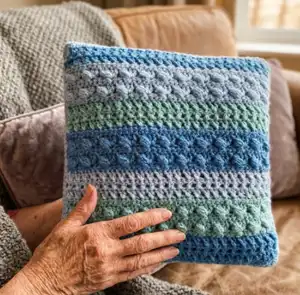
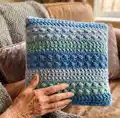
This pattern creates a textured Snowberry cushion cover made from two crocheted squares joined together and edged for a neat finish. It uses the Sideways Puff stitch to create eye-catching rows combined with treble/ double crochet rows for structure. You will make two identical panels in three colours, add a simple edged border and sew them together to fit a 14" x 14" pillow form.

Snowberry cushion cover Pattern crochet pattern - detailed view of completed project

The pattern is written in both UK and US terms with step-by-step rows and a photo-assisted special stitch tutorial. Suitable for intermediate crocheters who want a satisfying weekend project with a polished result.

Why You'll Love This Snowberry cushion cover Pattern

I absolutely love this pattern because it combines texture and simplicity in the most satisfying way. The Sideways Puff stitch creates beautiful raised clusters that look far more complicated than they are, and I enjoy how quickly the repeated stripes come together. I also appreciate that the pattern is flexible with colour choices β€” I experimented with three soft blues and it made the cushion pop. Making two matching squares and sewing them up is a lovely finishing task that always feels rewarding when the pillow form goes in and the cover comes to life.

Snowberry cushion cover Pattern step 1 - construction progress Snowberry cushion cover Pattern step 2 - assembly progress Snowberry cushion cover Pattern step 3 - details and accessories Snowberry cushion cover Pattern step 4 - final assembly and finishing

Switch Things Up

I love how easily this pattern can be personalized with color choices; try pastel shades for a soft nursery look or bold brights for a statement cushion.

To change the size, simply adjust the starting chain in multiples that match the stitch repeat, or swap yarn weights and a suitable hook for a larger or smaller finished cushion.

I often change the stripe sequence to create asymmetrical effects or repeat one colour more to emphasize a favourite tone.

For a cozier version, use a bulky aran yarn and a larger hook to get a plush, chunky texture that sits beautifully on sofas.

If you want a more refined finish, use the same yarn but single crochet the edge rounds for a flatter, subtle border instead of the two-round DC border.

I sometimes add a zipper to one edge instead of sewing all sides closed so the cover is removable and machine washable β€” just make sure to line up your stitches carefully.

Try embroidering a small label or initials on one corner for a personalized gift-ready cushion.

Combine this cushion with other textures in a set β€” the Snowberry stitch pairs well with cables or granny stripe cushions to create a layered look.

Experiment with ombre yarns for a gradient stripe effect that requires no color changes from you, keeping the pattern simple and dramatic at the same time.

I encourage you to make two different colourways and swap them seasonally β€” it's an easy way to refresh your decor without making a whole new cushion each time.

Common Mistakes & How to Fix Them

βœ— Starting rows with the wrong chain count can shift your stitch placement; always work the correct starting chains and note whether CH 1 or CH 2 counts as a stitch. βœ— Missing the standing stitch when joining new colours may create a gap at the join; use a standing TR/HTR/DC or make CH1/CH2 plus the first stitch in the same st to avoid holes. βœ— Skipping the hidden corner stitch at the joins will misalign corners; look for the hidden stitch under corner stitches and include it when working around edges. βœ— Not weaving in ends often makes finishing tedious and messy; weave in ends every 8-10 rows and after edges to keep the project tidy and manageable.

Snowberry cushion cover Pattern

Make a beautiful Snowberry cushion cover using simple stitches and the textured Sideways Puff stitch. This pattern guides you through two matching squares, a neat border and easy finishing so you can sew up a plush 14 x 14 inch cushion. Perfect for using three complementary aran shades and creating a cosy, handmade home accent you will love to display.

Intermediate 5-7 Hours

Materials Needed for Snowberry cushion cover Pattern

β€” Main Fabric

  • 01
    Paintbox Yarns Simply Aran - Dolphin Blue (Color 1) approx. 161 yards / 147 meters (80 grams)
  • 02
    Paintbox Yarns Simply Aran - Washed Teal (Color 2) approx. 100.5 yards / 92 meters (50 grams)
  • 03
    Paintbox Yarns Simply Aran - Duck Egg Blue (Color 3) approx. 161 yards / 147 meters (80 grams)
  • 04
    Extra yarn to sew the two squares together and for weaving in ends

β€” Tools Required

  • 01
    Crochet hook size 5.0 mm (H)
  • 02
    Yarn needle for sewing and weaving in ends
  • 03
    Scissors
  • 04
    14" x 14" pillow form
  • 05
    Stitch markers (optional)

Progress Tracker

0% Complete

β€” Special Stitches :

Info :

Sideways Puff Stitch (SWPuff ST): Before you make a sideways puff stitch you always have 3 TR STS (Picture 1). Yarn over hook, insert hook in indicated stitch (this is going to be the ST you put the first TR into the base of the first TR, NOT the TR itself!), pull up a long loop through that stitch/space (3 loops on hook) (Picture 2). Yarn over hook again and insert hook into the same stitch, pull up a loop (same height as the previous one) 3 more times. You should have 9 loops on your hook. Yarn over and pull through 8 loops (2 loops on your hook), yarn over and pull through both loops.

Infos :

Pictures 1-9 show step-by-step images for the SWPuff ST. Gauge: 3 HTR = 1" (3 HTR = 2.5 cm). Additional notes: If a row/round starts with a Chain 1, it is not counted as a stitch unless stated otherwise. Slip stitches do not count as stitches. Chain 2 always count as treble crochet. UK terms used throughout (or see US terms section for DC/HDC equivalents). Weave in the ends after every 8-10 rows to reduce loose ends to weave in at the end. Notes are written in a different color (brackets) to help you through the pattern. When working on the corners, always remember there might be a hidden stitch under the corner stitches which is the first stitch of the previous row. You can start each round as I did in the pattern or use a standing stitch or chains, it is up to you!

β€” Instructions (UK Terms) :

Make 2 :

To start: With Color 1 (Dolphin Blue) CH 52

Row 1 :

1 TR into the 4th CH from the hook, 1 TR in each CH to end

TURN :

Turn your work

Row 2 :

CH 2 (counts as TR), {SK 1 ST, 1 TR in next ST, 1 TR in skipped ST} 24 times, 1 TR in top of 3 CH (50 TR)

TURN :

Turn your work

Row 3-4 :

Same as Row 2

Fasten off :

Fasten off and fasten securely

Row 5 (WS) :

Join Color 2 (Washed Teal) to the last ST of last row with a standing HTR or alternatively, you can CH 1 and HTR in same ST. 1 HTR in next 48 STS, 1 HTR in top of CH 2

TURN :

Turn your work (50 HTR)

Row 6 (RS) :

CH 2 (counts as TR), {1 TR in next 3 STS, 1 SWPuff ST, SK 1 ST} 12 times, 1 TR in last ST (38 TR, 12 SWPuff ST)

TURN :

Turn your work

Row 7 (WS) :

CH 1, 1 HTR in same ST, 1 HTR in next 48 STS, 1 HTR in top of CH 2 (50 HTR)

TURN :

Turn your work

Row 8-9 :

Same as Row 6-7

Fasten off :

Fasten off

Row 10 (RS) :

Join Color 3 (Duck Egg Blue) to the last ST of last row with a standing TR or alternatively, you can CH 1 and TR in same ST. {SK 1 ST, 1 TR in next ST, 1 TR in skipped ST} 24 times, 1 TR in last ST

TURN :

Turn your work

Row 11-12 :

Same as Row 2. Fasten off.

Row 13 (WS) :

Join Color 1 (Dolphin Blue) to the last ST of last row with a standing HTR or alternatively, you can CH 1 and HTR in same ST. Same as Row 5

TURN :

Turn your work (50 HTR)

Row 14-17 :

Repeat Row 6-7 twice. Fasten off.

TURN :

Turn your work

Row 18-20 :

Join Color 2 (Washed Teal) to the last ST of last row with a standing TR or alternatively, you can CH 1 and TR in same ST. Same as Row 10-12. Fasten off.

TURN :

Turn your work

Row 21-25 :

Join Color 3 (Duck Egg Blue) to the last ST of last row with a standing HTR or alternatively, you can CH 1 and HTR in same ST. Same as Row 13-17. Fasten off.

TURN :

Turn your work (50 HTR)

Row 26-28 :

Join Color 1 (Dolphin Blue) to the last ST of last row with a standing TR or alternatively, you can CH 1 and TR in same ST. Same as Row 10-12. Fasten off.

β€” Edge :

Round 1 :

Join Color 3 (Duck Egg Blue) to the first ST of last Row (that’s the top right corner on the right side). CH 1, 2 DC in same ST, 1 DC in next 48 STS, 3 DC in next ST, DC 48 evenly on the side, 3 DC into the base of 3 CH, 1 DC in next 48 CH, 3 DC in last CH, DC 48 evenly on the side, 1 DC into the first ST with the 2 DC in it, join with a SLST to first DC. (Corner: 3 DC. Sides: 48 DC)

Round 2 :

CH 1, 2 DC in same ST, 1 DC in next 50 STS, 3 DC in next ST, 1 DC in next 50 STS, 3 DC in next ST, 1 DC in next 50 STS, 3 DC in next ST, 1 DC in next 50 STS, 1 DC in first ST with the 2 DC in it, join with a SLST to first DC. Fasten off, weave in all ends. (Corner: 3 DC. Sides: 50 DC)

β€” Finishing :

Info :

As you have 2 squares (one for each side), line them up, facing with the right side. Start in one of the corners and start sewing the sides together with the yarn left from the project (I used the Duck Egg Blue shade). When you have sewn 3 sides together, insert the pillow form, continue to sew up the last side and then weave in the loose ends.

β€” Instructions (US Terms) :

Make 2 :

To start: With Color 1 (Dolphin Blue) CH 52

Row 1 :

1 DC into the 4th CH from the hook, 1 DC in each CH to end

TURN :

Turn your work

Row 2 :

CH 2 (counts as DC), {SK 1 ST, 1 DC in next ST, 1 DC in skipped ST} 24 times, 1 DC in top of 3 CH (50 DC)

TURN :

Turn your work

Row 3-4 :

Same as Row 2

Fasten off :

Fasten off

Row 5 (WS) :

Join Color 2 (Washed Teal) to the last ST of last row with a standing HDC or alternatively, you can CH 1 and HDC in same ST. 1 HDC in next 48 STS, 1 HDC in top of CH 2 (50 HDC)

TURN :

Turn your work

Row 6 (RS) :

CH 2 (counts as DC), {1 DC in next 3 STS, 1 SWPuff ST, SK 1 ST} 12 times, 1 DC in last ST (38 DC, 12 SWPuff ST)

TURN :

Turn your work

Row 7 (WS) :

CH 1, 1 HDC in same ST, 1 HDC in next 48 STS, 1 HDC in top of CH 2 (50 HDC)

TURN :

Turn your work

Row 8-9 :

Same as Row 6-7

Fasten off :

Fasten off

Row 10 (RS) :

Join Color 3 (Duck Egg Blue) to the last ST of last row with a standing DC or alternatively, you can CH 1 and DC in same ST. {SK 1 ST, 1 DC in next ST, 1 DC in skipped ST} 24 times, 1 DC in last ST

TURN :

Turn your work

Row 11-12 :

Same as Row 2. Fasten off.

Row 13 (WS) :

Join Color 1 (Dolphin Blue) to the last ST of last row with a standing HDC or alternatively, you can CH 1 and HDC in same ST. Same as Row 5

TURN :

Turn your work (50 HDC)

Row 14-17 :

Repeat Row 6-7 twice. Fasten off.

TURN :

Turn your work

Row 18-20 :

Join Color 2 (Washed Teal) to the last ST of last row with a standing DC or alternatively, you can CH 1 and DC in same ST. Same as Row 10-12. Fasten off.

TURN :

Turn your work

Row 21-25 :

Join Color 3 (Duck Egg Blue) to the last ST of last row with a standing HDC or alternatively, you can CH 1 and HDC in same ST. Same as Row 13-17. Fasten off.

TURN :

Turn your work (50 HDC)

Row 26-28 :

Join Color 1 (Dolphin Blue) to the last ST of last row with a standing DC or alternatively, you can CH 1 and DC in same ST. Same as Row 10-12. Fasten off.

Assembly Instructions

  • Line up the two crocheted squares with right sides facing and match stripes and colours before sewing to ensure alignment.
  • Start sewing at one corner with the yarn tail from the most recent color, use a mattress stitch or whipstitch to join the edges evenly for a neat seam.
  • Sew three sides together, then insert the 14" x 14" pillow form and finish sewing the last side closed, adjusting stuffing for an even finish.
  • Weave in all loose ends securely after sewing, trimming any excess yarn close to the knot to tidy up the finished cushion.
  • When sewing corners, check for the hidden stitch under corner stitches and include it in the seam to avoid gaps and ensure square corners.

Important Notes

  • πŸ’‘Use stitch markers to keep track of your rounds and pattern repeats to avoid losing place during colour changes or SWPuff rows.
  • πŸ’‘Weave in ends after every 8-10 rows to reduce the number of loose ends to handle at the end of the project.
  • πŸ’‘Keep consistent tension throughout to ensure both squares match in size for an even finished cushion.

This Snowberry cushion cover pattern is a lovely blend of texture and simplicity, perfect for brightening any room with handmade charm. Make two panels, sew them neatly together and slip in a 14" pillow for an instant cozy accent. Share your finished cushion and enjoy the compliments it brings! 🧢🏑

You ask,

we answer.

FAQs

What size will the finished piece be?

The finished cushion cover fits a 14" x 14" (37 cm x 37 cm) pillow form when you use the recommended yarn and 5.0 mm hook.

Can I use different yarn weights for this pattern?

Yes, you can use different yarn weights but this will change the final size and texture; choose an appropriate hook for the yarn you select and check your gauge.

Do I need prior crochet experience for this pattern?

This pattern is rated intermediate, so familiarity with basic stitches like chains, double/treble crochet and reading row instructions is recommended.

How long does this project typically take to complete?

Most crocheters complete this project in 5-7 hours, depending on experience and pace; allow more time if you’re trying the Sideways Puff stitch for the first time.