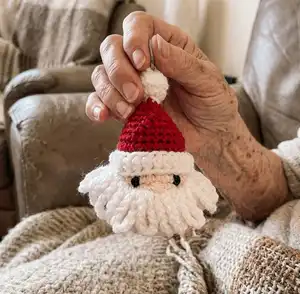
🧢 Beautiful ✨ Detailed πŸ’ Adorable

Santa Keychain Amigurumi Pattern

Santa Keychain Amigurumi Pattern
4.8β˜… Rating
2-3 Hours Time Needed
1.3K Made This
βœ‚οΈ

Intermediate Level

Ideal for those with basic crochet experience, featuring slightly more advanced stitches and techniques to expand your skills.

⏱️

Bite-Sized Project

Finishes in 2-4 hoursβ€”perfect for an afternoon of creative relaxation.

🎁

Tiny Treasure

Small, sweet, and gift-worthy creations that fit perfectly in the palm of your hand with detailed charm.

About This Santa Keychain Amigurumi Pattern

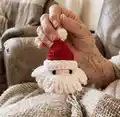
This pattern creates a tiny Santa keychain amigurumi with a detailed beard, hat, and bobble. The design uses DK weight yarn and a small 3mm hook to make a compact, gift-ready ornament. Youll work short rounds, front post stitches and looped beard techniques to get the textured look. Clear diagrams are referenced throughout to help with tricky steps and finishing.

Santa Keychain Amigurumi Pattern crochet pattern - detailed view of completed project

The finished piece is lightweight and perfect for keyrings or decorations, using only small yarn oddments. The pattern is written in UK terms and includes diagrams for beard loops, bobble construction, and hat band placement.

Why You'll Love This Santa Keychain Amigurumi Pattern

I absolutely love this pattern because it turns tiny yarn scraps into a festive, handmade keepsake. I adore the way the looped beard creates instant character with a simple technique that looks much more complex than it is. I enjoy making several at once for gifts β€” theyre quick to make and highly addictive. Im proud of the clear step-by-step diagrams included to help you master the bobble and beard loop techniques.

Santa Keychain Amigurumi Pattern step 1 - construction progress Santa Keychain Amigurumi Pattern step 2 - assembly progress Santa Keychain Amigurumi Pattern step 3 - details and accessories Santa Keychain Amigurumi Pattern step 4 - final assembly and finishing

Switch Things Up

I love adapting this tiny Santa to different colour palettes; try pastel pinks and greys for a modern twist or classic greens and creams for a vintage look.

I often change yarn weight and hook size to make variations; use a thicker DK or aran yarn with a larger hook for a chunky ornament, or a finer yarn for a delicate mini keyring.

I like to replace the sewn eyes with small safety eyes for a more polished look, but you can also embroider different expressions to personalise each Santa.

To make a magnet version, simply attach a small disc magnet to the back of the head instead of a keyring; it makes a sweet fridge decoration or party favour.

I sometimes embroider tiny spectacles or add a felt scarf for personality β€” tiny accessories really elevate the finished amigurumi.

If you want a standing ornament, add a small flat felt base sewn to the bottom of the head to give extra stability on display surfaces.

Try substituting the bobble with a small pom-pom in a contrasting yarn for a playful finish β€” secure it well to the top of the hat.

I like to make sets of Santas with matching hat colours for gifting; they look lovely grouped in a little gift box or on a festive garland.

For a luxe version, use a metallic or textured yarn for the hat trim and band; it adds a subtle shine without changing the construction.

When I teach this pattern, I encourage crocheters to experiment with beard length by varying loop chain lengths and loop placement to create different facial shapes.

Common Mistakes & How to Fix Them

βœ— Not marking the end of rounds can cause confusion when shaping the head and hat; place a stitch marker at the last stitch of each round to keep your place. βœ— Overstuffing the head and hat will make seams and stitches stretch and show stuffing; stuff gradually and only until the piece can be gently pinched. βœ— Skipping counts for the beard loops or chains will make the beard uneven; count and mark the slip stitch base points before creating loops to ensure symmetry. βœ— Pulling loops or bobble stitches too tight during finishing can flatten the texture; secure ends gently and shape loops with light tension to keep them fluffy. βœ— Not positioning the hat band correctly can result in a crooked brim; pin the band in place so the base touches the top of the hair before sewing with small back stitches. βœ— Failing to secure the keyring to the bobble firmly will cause the ring to come loose; use small back stitches and weave the end through the bobble before cutting flush to ensure durability.

Santa Keychain Amigurumi Pattern

Make a charming Santa keychain with this clear UK-term crochet pattern. Perfect for holiday gifts, decorations, or stocking fillers, you will create a tiny Santa with a fluffy beard and little bobble hat. The pattern uses small amounts of DK yarn and simple shaping techniques to produce an adorable finished piece you can attach to a keyring.

Intermediate 2-3 Hours

Materials Needed for Santa Keychain Amigurumi Pattern

β€” Main Fabric

  • 01
    Hayfield Bonus (DK) White 0961 61 61 61 61 61 61 61 4g (approximately 4g used)
  • 02
    Hayfield Bonus (DK) Peaches 0888 3g (approximately 3g used)
  • 03
    Hayfield Bonus (DK) Ladybird 0698 3g (approximately 3g used)
  • 04
    Hayfield Bonus (DK) Black 0965 oddment for eyes

β€” Tools Required

  • 01
    Keychain (small keyring)
  • 02
    Hi-Loft Quality Toy Stuffing (small amount)
  • 03
    3mm Crochet Hook
  • 04
    Wool Needle (for sewing and weaving ends)
  • 05
    Scissors
  • 06
    Stitch Marker (to mark rounds)
  • 07
    Pins for assembly (optional)

Progress Tracker

0% Complete

β€” Materials :

Info :

Hayfield Bonus (DK) White 0961 61 4g. Hayfield Bonus (DK) Peaches 0888 3g. Hayfield Bonus (DK) Ladybird 0698 3g. Hayfield Bonus (DK) Black 0965 Oddment for Eyes. Keychain. Hi-Loft Quality Toy Stuffing. 3mm Crochet Hook. Wool Needle (for sewing).

β€” Abbreviations :

Infos :

ch 61 chain. dc 61 double crochet. htr 61 half treble crochet. inc 61 2 stitches into next stitch. dec 61 decrease over next two stitches in front loops only. FLO 61 front loops only. sl st 61 slip stitch. f/o 61 fasten off by slip stitch in next stitch. y/o 61 yarn over. cl 61 (y/o, pick up st) x3, y/o, take each stitch individually over last y/o to form single cluster stitch. FP(tr) 61 front post (treble) worked through the front, right to left.

β€” Note :

Info :

Unless stated work in continuous rounds marking last stitch of each row with a stitch marker before proceeding with the next. When stuffing parts make sure that you don 27t overstuff them as you don 27t want the stuffing to show through when complete. Each part should be filled just enough that it can be easily squeezed when pinched firmly.

β€” Head :

Row 1 :

ch2, dc 6 into 2nd st from hook (alternatively dc 6sts into magic ring) (6)

Row 2 :

inc x6 (12)

Row 3 :

(dc into next st, inc) x6 (18)

Row 4 :

(dc into the next 2sts, inc) x6 (24)

Rows 5-7 :

dc (24) (3 rows)

Row 8 :

dc into the next 5sts, FPtr into the dc 2 rows below, dc into next 5sts, cl, dc into the next 5sts, FPtr into the dc 2 rows below, dc into next 6sts (24) (Diagrams 1 61 7)

Row 9 :

dc into the next 5sts, FPtr into the previous tr, dc into next 11sts, FPtr into the previous tr, dc into next 6sts (24) (Diagrams 8 61 9)

Row 10 :

dc (24) sl st to join

Info :

F/O leaving a short end

Row 1 (alt) :

ch2, sc 6 into 2nd st from hook (alternatively sc 6sts into magic ring) (6)

Row 2 (alt) :

inc x6 (12)

Row 3 (alt) :

(sc into next st, inc) x6 (18)

Row 4 (alt) :

(sc into the next 2sts, inc) x6 (24)

Rows 5-7 (alt) :

sc (24) (3 rows)

Row 8 (alt) :

sc into the next 5sts, FPdc into the sc 2 rows below, sc into next 5sts, cl, sc into the next 5sts, FPdc into the sc 2 rows below, sc into next 6sts (24) (Diagrams 1 61 7)

Row 9 (alt) :

sc into the next 5sts, FPdc into the previous dc, sc into next 11sts, FPdc into the previous dc, sc into next 6sts (24) (Diagrams 8 61 9)

Row 10 (alt) :

sc (24) sl st to join

Info :

F/O leaving a short end

β€” Hair and Beard :

Row 1 :

Using White: sl st into F/O st, sl st into next 6sts, (you should be just in front of the ear, adjust if not), slip st at an angle down the face for the next 3sts, moving 1 row and a st down the face each time, sl st straight across for the next 6sts (the 3rd and 4th st should be central to the base of the nose), slip st at an angle up the face for the next 3sts, moving 1 row and a st up the face each time, (you should be just in front of the 2nd ear), sl st into the next 6sts (24) sl st to join (Diagrams 10 61 11)

Row 2 :

(ch7, sl st through the next sl st from the previous row) x5, (ch9, sl st through the next sl st on beard shaping) x12, (ch7, sl st through the next sl st from the previous row) x7 (12 loops Beard, 12 loops Hair) (Diagrams 12 61 13)

Info :

F/O leaving a short end

β€” Hat :

Row 1 :

Using Ladybird: sl st into F/O st on peaches row at top of head, dc into next 24sts (24) (Diagrams 14 61 16)

Rows 2-3 :

dc (24) (3 rows)

Row 4 :

(dc into the next 6sts, dec) x3 (21)

Row 5 :

(dc into the next 5sts, dec) x3 (18)

Row 6 :

(dc into the next 4sts, dec) x3 (15)

Row 7 :

(dc into the next 3sts, dec) x3 (12)

Row 8 :

(dc into the next 2sts, dec) x3 (9)

Info :

Stuff head and hat

Row 9 :

(dc into next st, dec) x3 (6)

Info :

F/O leaving a short end.

Row 1 (alt) :

Using Ladybird: sl st into F/O st on peaches row at top of head, sc into next 24sts (24) (Diagrams 14 61 16)

Rows 2-3 (alt) :

sc (24) (3 rows)

Row 4 (alt) :

(sc into the next 6sts, dec) x3 (21)

Row 5 (alt) :

(sc into the next 5sts, dec) x3 (18)

Row 6 (alt) :

(sc into the next 4sts, dec) x3 (15)

Row 7 (alt) :

(sc into the next 3sts, dec) x3 (12)

Row 8 (alt) :

(sc into the next 2sts, dec) x3 (9)

Info :

Stuff head and hat

Row 9 (alt) :

(sc into next st, dec) x3 (6)

Info :

F/O leaving a short end.

β€” Bobble :

Row 10 :

Using White: leaving a 20cm end, sl st into st to right of F/O st, (Diagram 17) (sc into next st, inc) x3 making sure that the end is to the outside sl st to join (End will be used to shape bobble) (9)

Rows 11-12 :

sc (9) (2 rows)

Info :

Stuff bobble

Row 13 :

(sc into next st, dec) x3 (6)

Info :

F/O leaving a 20cm end. (Diagram 18)

Info :

Thread F/O end through the front loops of the last 6sts and pull tight to gather. (Diagram 19) Secure end with a couple of small sts. Using small back sts attach the keychain to the top of the bobble. Secure with a couple of small sts. Weave end through bobble and cut flush. Using 20cm end from start of babble thread through the base of the 1st row of white sts and pull tight to gather. (Diagram 20) Secure end with a couple of small sts. (Diagram 21) Weave end through Head and cut flush.

β€” Hat Band :

Row 1 :

Using White: leaving a 25cm end, ch24(24) sl st to join

Row 2 :

ch1, htr into the next 23ch (24) sl st to join

Info :

F/O leaving a 25cm end (Diagram 22)

Info :

Place hat band on head so that the base is touching the top of the hair. Using each 25cm end in turn, attach both sides of the band to the head using small back sts. (Diagrams 23 61 24) Secure ends with a couple of small sts before threading through head and cutting flush.

β€” Eyes :

Info :

Using black oddment thread through to front of face, 1 row up from top of nose and 2sts to outside. Sew 3 small back sts 1 row in length to form 1st eye. Thread through to opposite side of face and repeat for 2nd eye. (Diagram 25 61 26) Weave end through head and cut flush.

Assembly Instructions

  • Attach the hat band to the head so that the base of the band is touching the top of the hair; use the 25cm ends and small back stitches to secure both sides, then weave ends through the head and cut flush.
  • Sew the bobble to the tip of the hat by first securing the keyring to the top of the bobble with small back stitches, then attach the bobble to the hat and secure with several small stitches.
  • Place the beard and hair slip-stitch row in front of the ears as instructed, then create the looped beard and hair chains; position and adjust loops before fastening off and trimming ends.
  • Sew the hat to the head opening if necessary, making sure the hat brim sits over the hair row for a neat finished look; sew with small secure stitches around the join.
  • Finish facial details by sewing three small back stitches for each eye using black oddment thread, then weave all ends through the head and cut flush.

Important Notes

  • πŸ’‘Work in continuous rounds unless otherwise stated and mark the last stitch of each row with a stitch marker before proceeding.
  • πŸ’‘When stuffing, add filling gradually; overstuffing will distort shape and show through the stitches.
  • πŸ’‘Pin parts into place before sewing to check symmetry and alignment of hat, beard, and eyes.
  • πŸ’‘Weave in ends securely and cut flush to prevent loose ends from showing on the finished keychain.

This delightful Santa Keychain pattern brings cosy holiday charm to small spaces and makes wonderful handmade gifts. The tiny design uses minimal yarn yet achieves a detailed beard, hat, and bobble that look professionally finished. Make a few in different colours and scatter them as festive treasures around your home or gift them to family and friends. 🎁🧢

You ask,

we answer.

FAQs

What size will the finished piece be?

The finished keychain is a small amigurumi that measures approximately 6-8 cm tall depending on your tension and yarn, perfect for a keyring or bag charm.

Can I use different yarn weights for this pattern?

Yes, but changing yarn weight will alter the final size; use an appropriate hook size and adjust stitch counts if necessary to maintain proportions.

Do I need prior crochet experience for this pattern?

This pattern is rated intermediate and requires familiarity with basic stitches plus techniques like front post stitches, looped loops for the beard, and bobble finishing.

How long does this project typically take to complete?

Most crafters complete this project in 2-4 hours; if you make several at once you will become faster as you repeat the same steps.

How should I attach the keyring for durability?

Attach the keyring to the bobble using small back stitches, secure with a couple of extra stitches and weave the ends through the bobble before trimming to ensure it holds during use.