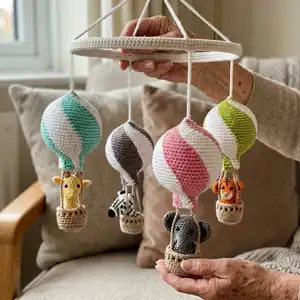
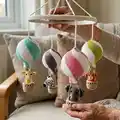
Make a charming hot air balloon baby mobile with four swirled balloons and tiny amigurumi animals. This pattern walks you through tapestry crochet for the balloons, baskets, and four animal pals with clear step-by-step rounds. You will assemble a covered wooden frame and attach the balloons for a beautiful nursery mobile. Perfect for gifting or decorating a baby room with handmade love.
Progress Tracker
0% Complete
— Hot Air Balloon :
Info :
Work with the Tapestry crochet method (Carrying the second color along top of single crochet being worked in) (pic.1)
Round 1 :
Magic ring, 6 ch in ring (6)
Round 2 :
* 2sc with COLOR A, 2sc with COLOR B * 6 times (12)
Round 3 :
skip 1 st, * (sc, 2sc with COLOR A), (sc, 2sc with COLOR B) * 6 times (18)
Round 4 :
* (sc in next 2 st, 2sc) with COLOR A, (sc in next 2 st, 2sc) with COLOR B * 6 times (24)
Info :
As you can see, from R3 every increase will be made in the stitch AFTER the increase stitch of the previous row (NOT in the same st, as you usually do). This makes the balloon stripes more 'swirly'. (pic.2)
Round 5-11 :
continue increasing in the same way (6 increases for every row) (66)
Round 12-19 :
8 rows even (* 11 st with COLOR A, 11 st with COLOR B * 6 times) (66)
Info :
In rows from 12 to 19, every color change will be made in the stitch AFTER the last stitch of a color. (pic.6)
Info :
Insert the polystyrene ball before finishing increases to shape the balloon. (pic.8)
Round 20 :
* (sc in next 9 st, sc2tog with COLOR A), (sc in next 9 st, sc2tog with COLOR B) * 6 times (60 st)
Round 21-26 :
continue decreasing (6 decreases in every row) (24)
Info :
In rows from 20 to 26, every decrease will be made between the last COLOR A stitch and the first COLOR B stitch.
Round 27-31 :
5 rows even (* sc in next 4 st with COLOR A, sc in next 4 st with COLOR B * 6 times) (24)
Round 32 :
Break the yarn and fasten off.
— Basket :
Round 1 :
Magic ring, 6 ch in ring (6)
Round 2 :
2sc in each ch (12)
Round 3 :
* sc, 2sc * 6 times (18)
Round 4 :
* sc in next 2 st, 2sc * 6 times (24)
Round 5 :
* sc in next 3 st, 2sc * 6 times, sl st in first st (30)
Round 6 :
Ch1, (back loop only) sc in same st, sc in next 29 st, sl st in first st (30)
Round 7 :
Ch1, sc in same st, sc in next 29 st, sl st in first st (30)
Round 8-9 :
Same as R7 (30)
Round 10 :
Ch4, skip 1 st, * hdc in next st, ch2, skip 1 st * 14 times, sl st in 3° ch (44)
Round 11 :
2 sc in spaces between every hdc, sl st in first st (30)
Round 12 :
Ch15 (create the first hanging string). Break the yarn and leave a long strand.
Info :
- Join yarn in 8° st from the previous string (skipping 7 st), ch15. Break the yarn and leave a long strand. - Join yarn in 8° st from the previous string (skipping 7 st), ch15. Break the yarn and leave a long strand. - Join yarn in 7° st from the previous string (skipping 6 st), ch15. Break the yarn and leave a long strand. (pic.15)
— Elephant :
HEAD R1 :
Magic ring, 6 ch in ring (6)
HEAD R2 :
(Back loop only) even (6)
HEAD R3-4 :
2 rows even (6)
HEAD R5 :
* sc, 2sc * 3 times (9)
HEAD R7 :
* sc in next 2 st, 2sc * 3 times (12)
HEAD R9 :
* sc, 2sc * 6 times (18)
HEAD R10 :
* sc in next 2 st, 2sc * 6 times (24)
HEAD R11-14 :
4 rows even (24)
HEAD R15 :
* sc in next 2 st, sc2tog * 6 times (18)
HEAD R16 :
* sc, sc2tog * 6 times (12) Insert stuffing.
HEAD R17 :
* sc, sc2tog * 4 times (8)
HEAD Info :
Break the yarn and fasten off.
EARS (x2) :
Magic ring, 3 ch in ring, turn (3). Ch1, 2sc in each ch, turn (6). Ch1, * sc, 2sc * 3 times, turn (9). Ch1, even, turn (9). Ch1, even (9). Break the yarn and leave a long strand.
BODY R1 :
Magic ring, 6 ch in ring (6)
BODY R2 :
2sc in each ch (12)
BODY R3 :
* sc, 2sc * 6 times (18)
BODY R4 :
* sc in next 2 st, 2sc * 6 times (24)
BODY R5-11 :
7 rows even (24)
BODY R12 :
* sc in next 2 st, sc2tog * 6 times (18)
BODY R13 :
* sc, sc2tog * 6 times (12)
BODY R14 :
even (12). Break the yarn and leave a long strand. Insert stuffing.
— Assembly (Elephant) :
Info :
1 - Sew the ears on the head: Insert the long strand of the ear in the needle, insert the needle in the ear in order to make a little fold (do the same with the second ear, but in reverse). Sew each ear on the head (between R14 and R15 of HEAD), leaving a space of 6 st between each ear.
Info :
2 - Sew the head on the body.
Info :
3 - If you use glass beads instead of safety eyes, sew them on the head in the same place as previously explained for the safety eyes.
Info :
4 - Sew the elephant in the basket (it's easier if you do this turning the basket inside out).
Info :
5 - Attach the basket to the balloon: Attach the 4 strings of the basket to the balloon, leaving a space of 5 st between each one. Break the yarn and weave in ends. (pic.31)
— Giraffe :
EARS (x2) :
Ch4, sc in 2° ch from hook, sc in next 2 st (3). Break the yarn and leave a long strand.
HORNS (x2) :
Magic ring, 3 ch in ring (3). R2: Back loops only, even (3). R3: even (3). Break the yarn and leave a long strand.
HEAD R1 :
Magic ring, 6 ch in ring (6)
HEAD R2-3 :
2 rows even (6)
HEAD R4 :
* sc, 2sc * 3 times (9)
HEAD R6 :
* sc in next 2 st, 2sc * 3 times (12)
HEAD R8 :
* sc, 2sc * 6 times (18)
HEAD R9-11 :
3 rows even (18)
HEAD R12 :
* sc, sc2tog * 6 times (12)
HEAD R13 :
* sc, sc2tog * 4 times (8). Break the yarn and fasten off.
Info :
Attach the horns to the head. Attach the ears to the head.
BODY R1 :
Magic ring, 6 ch in ring (6)
BODY R2 :
2sc in each ch (12)
BODY R3 :
* sc, 2sc * 6 times (18)
BODY R4 :
* sc in next 2 st, 2sc * 6 times (24)
BODY R5-6 :
2 rows even (24)
BODY R7 :
* sc in next 2 st, sc2tog * 6 times (18)
BODY R9 :
* sc, sc2tog * 6 times (12)
BODY R11 :
* sc, sc2tog * 4 times (8)
BODY R12-15 :
4 rows even (8). Break the yarn and leave a long strand. Insert stuffing. Attach the head to the body. Sew the eyes on the head.
— Zebra :
EARS (x2) :
Ch4, sc in 2° ch from hook, sc in next st, * sc, hdc, sc * in last ch. On opposite side, sc in next 2 st, sl st in first st (7). Break the yarn and leave a long strand.
MANE :
Ch16, sc in 2° ch from hook, sc in next 14 ch, turn (15). Change color to Limone 24 Black. R2: Ch1, even (15). Break yarn and leave a long strand.
HEAD R1 :
Magic ring, 6 ch in ring (6)
HEAD R2 :
* sc, 2sc * 3 times (9)
HEAD R3 :
even (9). Change color to Limone 06 White.
HEAD R4-5 :
2 rows even (9)
HEAD R6 :
* sc in next 2 st, 2sc * 3 times (12)
HEAD R7-8 :
2 rows even (12)
HEAD R9 :
* sc, 2sc * 6 times (18)
HEAD R10-14 :
5 rows even (18)
HEAD R15 :
* sc, sc2tog * 6 times (12). Insert stuffing.
HEAD R16 :
* sc, sc2tog * 4 times (8). Break the yarn and fasten off.
BODY R1 :
Magic ring, 6 ch in ring (6)
BODY R2 :
2sc in each ch (12)
BODY R3 :
* sc, 2sc * 6 times (18)
BODY R4 :
* sc in next 2 st, 2sc * 6 times (24)
BODY R5-7 :
3 rows even (24)
BODY R8 :
* sc in next 2 st, sc2tog * 6 times (18)
BODY R9-11 :
3 rows even (18)
BODY R12 :
* sc, sc2tog * 6 times (12)
BODY R13-14 :
2 rows even (12)
BODY R15 :
Ch1, turn, skip 1st st, sc in next 6 st, turn (6)
BODY R16 :
Ch1, skip 1st st, sc in next 5 st, turn (5)
BODY R17 :
Ch1, skip 1st st, sc in next 4 sts, turn (4)
BODY R18 :
Ch1, skip 1st st, sc in next 3 sts (3). Break the yarn and leave a long strand. Insert stuffing. Attach the head to the body. Sew the eyes to the head. With a long strand of Limone 24 Black, embroider the zebra stripes on the head and the body. (pic.51-58)
— Tiger :
EARS (x2) :
Magic ring, 3 ch in ring, turn (3). Ch1, 2sc in each ch, turn (6). Ch1, even (6). Break the yarn and leave a long strand.
HEAD R1 :
Magic ring, 6 ch in ring (6)
HEAD R2 :
* sc, 2sc * 3 times (9)
HEAD R3 :
sc in next 2 st, 2sc, sc in next st. Change color to Mandarin: sc in next st, 2sc, sc in next st. Change color to Natur: sc in next st, 2sc (12)
HEAD R4 :
even (sc in next 5 st with Natur, sc in next 4 st with Mandarin, sc in next 3 st with Natur) (12)
HEAD R5 :
even (sc in next 5 st with Natur, sc in next 5 st with Mandarin, sc in next 2 st with Natur) (12)
HEAD R6 :
with Mandarin, * sc, 2sc * 6 times (18)
HEAD R7 :
* sc in next 2 st, 2sc * 6 times (24)
HEAD R8-11 :
4 rows even (24)
HEAD Info :
With a long strand of Limone 149 Blute, embroider the nose: from inside the head, pull the needle out of the center of the magic ring and follow the detailed steps to form a triangular nose area, pulling the needle out in specified points until a triangle is formed. Fasten off inside the head. (pic.60-66)
HEAD R12 :
* sc in next 2 st, sc2tog * 6 times (18)
HEAD R13 :
* sc, sc2tog * 6 times (12). Insert stuffing.
HEAD R16 :
* sc, sc2tog * 4 times (8). Break the yarn and fasten off.
Info :
Attach the ears to the head. Break the yarn and leave a long strand for sewing. (pic.68-69)
BODY R1 :
Magic ring, 6 ch in ring (6)
BODY R2 :
2sc in each ch (12)
BODY R3 :
* sc, 2sc * 6 times (18)
BODY R4 :
* sc in next 2 st, 2sc * 6 times (24)
BODY R5 :
even (sc in next 4 st with Mandarin, sc in next 4 st with Natur, sc in next 16 st with Mandarin) (24)
BODY R6-8 :
3 rows even (sc in next 4 st with Mandarin, sc in next 5 st with Natur, sc in next 15 st with Mandarin) (24)
BODY R9-11 :
3 rows even (sc in next 5 st with Mandarin, sc in next 5 st with Natur, sc in next 14 st with Mandarin) (24)
BODY R12 :
* sc in next 2 st, sc2tog * with Mandarin and Natur in the sequence described in the original pattern for shaping (18)
BODY R13 :
Follow decreases as described in the original pattern to shape the body to (12).
BODY R14 :
even (sc in next 3 st with Mandarin, sc in next 3 st with Natur, sc in next 6 st with Mandarin) (12). Break the yarn and leave a long strand.
Info :
Insert stuffing. Attach the head to the body. Sew the eyes to the head. With a long strand of Limone 24 Black, embroider the tiger stripes on the head and on the body. (pic.73-81)
— Mobile Frame :
Plastic Ring R1 :
with Limone 06 White: Ch1, sc around the ring until it's all covered. Break the yarn and fasten off. (pic.82-83)
Wooden Frame R1 :
with Limone 06 White: Ch210, sl st in first ch to form a ring (make sure that the chain isn't twisted when you close the ring) (210)
Wooden Frame R2-R10 :
Ch1, sc in same st, sc in next 209 st, sl st in first st (210)
Wooden Frame R11 :
Ch1, sl st in both sides (the foundation chains and the last row of sc together) to close, with the wooden frame inside. Break the yarn and fasten off.
Info :
Join white yarn in a random point of the frame (on the side opposite to the closing sts). Ch48, pass the hook through the little ring, skip 8 ch, sl st in next 40 ch. Break the yarn and fasten off. Do the same thing other 2 times, leaving a space of 8.7 inches (22 cm) between each thread. Join yarn in a random point on the opposite side of the frame, Ch20, pass the hook through the top of a hot air balloon, sl st in every ch, break the yarn and fasten off. Do the same thing other 3 times, spacing out the balloons evenly on the frame. Optionally hang 2 of them at a 20ch height and the other 2 at a 10ch height.
This handmade hot air balloon baby mobile brings a dreamy, whimsical touch to any nursery with four tiny animals tucked into woven baskets. The pattern uses tapestry crochet for beautiful swirled balloons and small amigurumi techniques for sweet, durable characters. Make it in soft pastels for a calming nursery or bright colors for a playful mobile — it makes a perfect gift! 🧶🎈