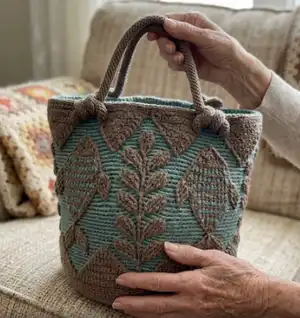
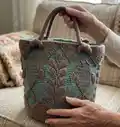
Make a stunning Corfu Bag using textured embossed crochet and front/back post stitches. This pattern guides you through the bottom, embossed sides, upper-edge backing and spiral cord handles so you can create a durable, stylish tote. Detailed charts, step-by-step photos and video references are included to help you every stitch of the way. Ideal for crafters who enjoy structured crochet and beautiful surface texture.
Progress Tracker
0% Complete
— Bag bottom :
Info :
Chart 1 on p.5. Note: In this section, the bag bottom is made entirely with front post stitches, so they are not highlighted.
Inc Rnd 1 :
with Yarn2 ch4, ss in 1st ch, ch2 (counts as dc), 8dc (make them as short as possible) in ch4-ring, ss in 2nd ch of beg ch-2. (9dc)
Inc Rnd 2 :
ch2 (doesn't count as st throughout bag bottom), F2i (in beg ch-2 from pr), 8F2i, sk ch-2 (throughout bag bottom), ss (in 1st F throughout bottom). (18F)
Inc Rnd 3 :
ch2, F2i (in 1st F from pr (ignore ch-2) throughout bottom), F, [F2i, F]x8, ss. (27sts)
Inc Rnd 4 :
ch2, [2F, F2i]x9, ss. (36sts)
Inc Rnd 5 :
ch2, [F2i, 3F]x9, ss. (45sts)
Inc Rnd 6 :
ch2, 2F, [F2i, 4F]x8, F2i, 2F, ss. (54 sts)
Inc Rnd 7 :
ch2, 4F, [F2i, 5F]x8, F2i, F, ss. (63sts)
Inc Rnd 8 :
ch2, [6F, F2i]x9, ss. (72sts)
Inc Rnd 9 :
ch2, [F2i, 7F]x9, ss. (81sts)
Inc Rnd 10 :
ch2, 2F, [F2i, 8F]x8, F2i, 6F, ss. (90sts)
Inc Rnd 11 :
ch2, 4F, [F2i, 14F]x5, F2i, 10F, ss. (96sts)
Inc Rnd 12 :
ch2, 6F, [F2i, 15F]x5, F2i, 9F, ss. (102sts)
Inc Rnd 13 :
ch2, 8F, [F2i, 16F]x5, F2i, 8F, ss. (108sts)
Inc Rnd 14 :
ch2, 10F, [F2i, 17F]x5, F2i, 7F, ss. (114sts)
Inc Rnd 15 :
ch2, 12F, [F2i, 18F]x5, F2i, 6F, ss. (120sts)
Inc Rnd 16 :
ch2, 14F, [F2i, 19F]x5, F2i, 5F, ss. (126sts)
Inc Rnd 17 :
ch2, 16F, [F2i, 20F]x5, F2i, 4F, ss. (132sts)
Inc Rnd 18 :
ch2, 18F, [F2i, 21F]x5, F2i, 3F, ss. (138sts)
Inc Rnd 19 :
ch2, 20F, [F2i, 22F]x5, F2i, 2F, ss. (144sts)
Inc Rnd 20 :
ch2, 22F, [F2i, 23F]x5, F2i, F, ss. (150sts)
Inc Rnd 21 :
ch2, [24F, F2i]x6, ss. (156sts)
Inc Rnd 22 :
ch2, [F2i, 38F]x4, ss. (160sts)
Inc Rnd 23 :
ch2, 2F, [F2i, 39F]x3, F2i, 37F, ss. (164sts)
Inc Rnd 24 :
ch2, 4F, [F2i, 40F]x3, F2i, 36F, ss. (168sts)
Inc Rnd 25 :
ch2, 6F, [F2i, 41F]x3, F2i, 35F, ss. (172sts)
Inc Rnd 26 :
ch2, 8F, [F2i, 42F]x3, F2i, 34F, with Yarn1 ss. (176sts)
Info :
Mark stitches for making B3i: pm in 1st F of Rnd 26, [sk 21F, pm in next F]x7 (21F rem to 1st F). (176sts)
— Bag sides :
Info :
Chart 2 on next page. Written instructions do not remind you to switch yarn. Make highlighted stitches with Yarn2, all other stitches with Yarn1.
Rnd 27 :
(RS): with Yarn1 ch2 (counts as 1st B of B3i), shallow B2i in 1st F from pr (counts as 2nd and 3rd B of B3i), [*F2t, 17F, F2t*, shallow B3i]x7, rep bet *'s, ss in 2nd ch of beg ch-2.
Rnd 28 :
ch2 (counts as 1st B of B2i), B in same st (in ch-2 from pr; counts as 2nd B of B2i), [*B, B2i, F2t, 15F, F2t*, B2i]x7, rep bet *'s, ss in 2nd ch of beg ch-2.
Rnd 29 :
ch2 (counts as 1st B of B2i), B in ch-2 from pr (counts as 2nd B of B2i), [*3B, B2i, F2t, 13F, F2t*, B2i]x7, rep bet *'s, ss in 2nd ch of beg ch-2.
Rnd 30 :
ch2 (counts as 1st B of B2i), B in ch-2 from pr, [*2B, F, 2B, B2i, F2t, 11F, F2t, B2i, 5B, B2i, F2t, 11F, F2t*, B2i]x3, rep bet *'s, ss in 2nd ch of beg ch-2.
Rnd 31 :
ch2 (counts as 1st B of B2i), B in ch-2 from pr, [*3B, F, 3B, B2i, F2t, 9F, F2t*, B2i]x7, rep bet *'s, ss in 2nd ch of beg ch-2.
Rnd 32 :
ch2 (counts as B), [*4B, F3i, 5B, F2t, 7F, F2t, B2i, 9B, B2i, F2t, 7F, F2t*, B]x3, rep bet *'s, ss in 2nd ch of beg ch-2.
Rnd 33 :
ch2 (counts as B), [*2B, B2t, F2i, hdc bet F's, F, hdc in bet F's, F2i, B2t, 3B, F2i, 3B, B2i, F3t (1st and 3rd legs in 2 posts), F2t, 5F, F2t*, B]x3, rep bet *'s, ss in 2nd ch of beg ch-2.
Rnd 34 :
ch2 (counts as B), [*B, B2t (2nd leg in 2 posts), 2 F2i, B in hdc, F, B in hdc, 2 F2i, B2t (1st leg in 2 posts), 2B, F2t, 3F, F2t, B2i, B, F2i, B2t, 5B, B2i, F2i, B2i, F2t, 3F, F2t*, B]x3, rep bet *'s, ss in 2nd ch of beg ch-2.
Info :
Shift beginning of round next to the embossed element to minimize visibility of ch-2 at the beg of each round: turn to WS, 7ss (in prev 7sts: F, 4B, B2i), turn.
Rnd 35 :
ch2 (counts as B), [*B2t (2nd leg in 2 posts), F2i, 3F, B2i, F, B2i, 3F, F2i, B2t (1st leg in 2 posts), B, F2t, F, F2t, B2i, 2B, 2 F2i, B2t (1st leg in 2 posts), B3t, B2t (2nd leg in 2 posts), 2F2i, 2B, B2i, F2t, F, F2t, B2i, 2B, 2F2i, B2t (1st leg in 2 posts) , B3t, B2t]x3, rep bet *'s, ss in 2nd ch of beg ch-2.
Rnd 36 :
ch2 (counts as B), [*B (in 2 posts), 5F, B2i, B, F, B, B2i, 5F, 2 B (1st in 2 posts), F3t (1st and 3rd legs in 2 posts), B2i, 3B, F2i, 3F, B3t (1st and 3rd legs in 2 posts; 2nd leg in 3 posts), 3F, F2i, 3B, B2i, F3t (1st and 3rd legs in 2 posts)*, B]x3, rep bet *'s, ss in 2nd ch of beg ch-2.
Rnd 37 :
ch2 (counts as B), [*B, F2t, F, F2t, B2i, 2B, F3i, 2B, B2i, F2t, F, F2t, 2B (finish with Yarn1), with Yarn2 F (in 3 posts of F3t) and finish with Yarn1, 4B, B2i, 4F, F3t (2nd leg in 3 posts), 4F, B2i, 4B (finish last B with Yarn1), with Yarn2 F (in 3 posts); finish with Yarn1]*, B]x3, rep bet *'s, ss in 2nd ch of beg ch-2.
Info :
Video Part 7 shows Rnds 35 and 37: https://youtu.be/7JA8oI7lNzU. Shift beg of rnd next to the embossed element to minimize visibility of ch-2 at the beg of each round.
Rnd 38 :
ch2 (counts as 1st B of B2i), B in same st (in 1st B after F from pr; counts as 2nd B of B2i), [*8B (6th in F; finish last B with Yarn1), with Yarn2 F3t (1st and 3rd legs in 2 posts; finish with Yarn1), 4B, F2i, hdc in bet F's, F, hdc in bet F's, F2i, 4B (finish last B with Yarn1), with Yarn2 F3t (1st and 3rd legs in 2 posts); finish with Yarn1, 8B (3rd in F), B2i, 3F, F3t (2nd leg in 3 posts), 3F*, B]x3, rep bet *'s, ss in 2nd ch of beg ch-2.
Rnd 39 :
ch2 (counts as 1st B of B2i), B in same st (in ch-2 from pr; counts as 2nd B of B2i), [*B2i, 9B (last is shallow B in F3t), 2 B2t, 2 F2i, B in hdc, F, B in hdc, 2 F2i, 2 B2t, 6B, B2t (2nd leg in 2 posts), F2i, 7F, F2i*, B]x3, rep bet *'s, ss in 2nd ch of beg ch-2.
— Continuing Bag Sides (Rnds 40-56 preview) :
Rnd 40 :
ch2 (counts as 1st B of B2i), B in same st (in ch-2 from pr), [*10B, B2t, B2t (both legs in 2 posts), F2i, 3F, B2i, F, B2i, 3F, F2i, B2t (both legs in 2 posts), B2t, 10B, B2i, F3t (1st and 3rd legs in 2 posts; 2nd leg in 3 posts)*, B2i]x3, rep bet *'s, ss in 2nd ch of beg ch-2.
Rnd 41 :
ch2 (counts as 1st leg of B2t), B in 1st B after ch-2 from pr (counts as 2nd leg of B2t), [*10B, B2t (both legs in 2 posts), 5F, B2i, B, F, B, B2i, 5F, B2t (both legs in 2 posts), 10B, B2t, F3i (in 3 posts)*, B2t]x3, rep bet *'s, sk ch-2, ss in 1st B.
Rnd 42 :
ch2 (counts as 1st leg of B2t), B in 2nd B after ch-2 from pr (counts as 2nd leg of B2t), [*10B (last in 2 posts), F2t, F, F2t, B2i, 2B, F3i, 2B, B2i, F2t, F, F2t, 2B]*, rep bet *'s, sk ch-2, ss in 1st B.
Rnd 43 :
ch2 (counts as 1st leg of B2t), B in 2nd B after ch-2 from pr (counts as 2nd leg of B2t), [*9B and finish last st with Yarn1, with Yarn2 F3t (1st and 3rd legs in 2 posts) and finish with Yarn1, 4B, F2i, hdc in bet F's, F, hdc in bet F's, F2i, 4B and finish last st with Yarn1, with Yarn2 F3t (1st and 3rd legs in 2 posts) and finish with Yarn1, 9B, B2t (2nd leg in 2 posts), F2i, 3F, F2i*, B2i]x3, rep bet *'s, ss in 2nd ch of beg ch-2.
Rnd 44 :
ch2 (counts as 1st leg of B2t), B in 2nd B after ch-2 from pr (counts as 2nd leg of B2t), [*9B (last is shallow B in F3t), 2 B2t, 2 F2i, B in hdc, F, B in hdc, 2 F2i, 2 B2t, 9B, 2 F2i*, B]x3, rep bet *'s, ss in 2nd ch of beg ch-2.
Rnd 45 :
ch2 (counts as 1st leg of B2t), B in 2nd B after ch-2 from pr, [*6B, B2t, B2t (both legs in 2 posts), 5B, B2i, F2i*, B2i]x3, rep bet *'s, ss in 2nd ch of beg ch-2.
Rnd 46 :
ch2 (counts as B), [*6B, B2t (both legs in 2 posts), 5F, B2i, B, F, B, B2i, 5F, B2t (both legs in 2 posts), 7B (last in 2 posts), F and finish with Yarn1, fish stripe: with Yarn1 9F and finish with Yarn2, F*, B (in 2 posts)]x3, rep bet *'s, ss in 2nd ch of beg ch-2.
Rnd 47 :
ch2 (counts as B), [*2B (2nd in 2 posts), F2t, F, F2t, B2i, 2B, F3i, 2B, B2i, F2t, F, F2t, 3B (1st in 2 posts), F2i, 2 B2t, F2i, 9F, F2i, 2 B2t, F2i*, B]x3, rep bet *'s, ss in 2nd ch of beg ch-2.
Rnd 48 :
ch2 (counts as B), [*2B and finish last B with Yarn1, with Yarn2 F3t (1st and 3rd legs in 2 posts) and finish st with Yarn1, 4B, F2i, hdc in bet F's, F, hdc in bet F's, F2i, 4B and finish last B with Yarn1, with Yarn2 F3t (1st and 3rd legs in 2 posts) and finish st with Yarn1, 3B, F2i, F, B2t (both legs in 2 posts), F, F2i*, B]x3, rep bet *'s, ss in 2nd ch of beg ch-2. fish stripe: with Yarn1 11F and finish with Yarn2.
Rnd 49 :
ch2 (counts as B), [*3B (last is shallow B in F3t), 2 B2t, 2 F2i, B in hdc, F, B in hdc, 2 F2i, 2 B2t, 4B (1st is shallow B in F3t), F2i, F, F2t (1st leg in next F, sk B2t, 2nd leg in next F), F in same st as 2nd leg of prev F2t, 12F, F2t (1st leg in same st as last of 12F), sk B2t, 2nd leg in next F, F, F2i*, B]x3, rep bet *'s, ss in 2nd ch of beg ch-2.
Rnd 50 :
ch2 (counts as B), [*B, B2t, B2t (both legs in 2 posts), F2i, 3F, B2i, F, B2i, 3F, F2i, B2t (both legs in 2 posts), B2t, 2B, F2i, F, F2t*, B]x3, rep bet *'s, ss in 2nd ch of beg ch-2.
Info :
Continue following Chart 2 for rounds 26-86. Highlighted stitches are made with Yarn2 (all front post sts except fish stripes). Video references throughout pattern support many of these rounds.
— Upper edge backing :
Info :
To achieve consistent gauge throughout the pattern, 16sts are decreased in order to align the gauges of sc blo and F stitches. Work Dec Rnd 70 and Rnds 71-86 as written to prepare upper edge backing.
Dec Rnd 70 :
ch1 (doesn't count as st), sc blo in same st, [*3sc blo, sc2tog blo, 8sc blo, sc2tog blo*, 5sc blo]x7, rep bet *'s, 4sc blo, ss blo in 1st sc. (144sts)
Rnds 71-86 :
ch1 (doesn't count as st), sc blo in same st, 143sc blo, ss blo in 1st sc. Fasten off after Rnd 86. (144sts)
— Reinforcing upper edge backing with buckram :
Info :
Cut interfacing strip approximately 7cm x 80cm (2 3/4" x 31 1/2"). Apply to wrong side of upper edge backing, overlap short edges, baste and stitch. Use zig-zag or stretchable stitch to secure. Fold backing in and hand-stitch the edge to the wrong side if not lining the bag.
— Handles :
Handle attaching strip (x4) :
Row 1 (RS): locate 8 middle sts of Round 69, positioned above any fish, join Yarn2 in front post of 1st of those 8 sts, ch5, sc in 2nd ch from hook, 3sc, turn (4sc). Pictures show 10 sc rows, but for Corfu bag make only 1. Fasten off leaving 20cm/8" tail for seam.
Spiral cord handles (x2) :
With Yarn2 leave 30cm/12" tail, make 78cm/30 3/4" long 8-sts spiral cord, starting with one 4sc-row (video and pictures show 10 rows). Fasten off, leaving 30cm/12" tail. Measure while cord is fully stretched. Keep in mind spiral cord has stretch; insert narrow non-stretchable tape inside cord after creating approx 1cm of the cord to reduce stretching and sew tape ends to beginning and end of cord securely.
Loop at the end of spiral cord handle (x4) :
Measure and mark a distance of 15cm/5 7/8" from each end of the handle. Make loop at end as shown in photos and secure with loop seam cover strip.
Attach handles to the bag (x4) :
Insert handle attaching strip into the loop at the end of the handle ensuring loop seam cover is facing inner side of bag. Thread tapestry needle with 30cm/12" tail and sew attaching strip to the upper edge backing using small invisible stitches to secure seam; fold strip to WS and sew each stitch at the edge of the strip securely to both loops of one of the 8 stitches from which the strip was started. Secure seam by tying off and weaving in loose tail.
— Loop seam cover (x4) :
Info :
With Yarn2 ch14 and work 9 rows of slip stitch rib. Fasten off leaving 30cm/12" tail. Thread tapestry needle with tail and position strip over loop seam. Use overcast stitch to close short edges and secure seam. Weave in beginning tail when complete.
— Optional lining & Finishing :
Info :
Optional lining instructions: measure finished bag to determine length and width, add seam allowances as given, stitch sides together and overcast upper edge. Insert drawstring into 2cm/3/4" slit at bottom if desired. Tuck lining under upper edge backing and baste and hand-stitch with small invisible stitches. Weave in all ends. Hand-wash in lukewarm water, reshape and lay flat to dry.
This Corfu Bag pattern brings together embossed texture, elegant fish and leaf motifs, and a smart, reinforced finish to create a durable and beautiful tote. Whether you carry groceries or treasures, the bag keeps its shape and looks stunning on the shoulder. Enjoy the detailed charts, photo steps and video links included to guide you to a professional result. 🧶 Happy crocheting and enjoy making something gorgeous! ✨